“That’s stupid. How could Mighty Mouse beat up Superman? Mighty Mouse is a cartoon!”
Man, that’s faith. This is from the wonderful “Stand By Me.”
“That’s stupid. How could Mighty Mouse beat up Superman? Mighty Mouse is a cartoon!”
Man, that’s faith. This is from the wonderful “Stand By Me.”
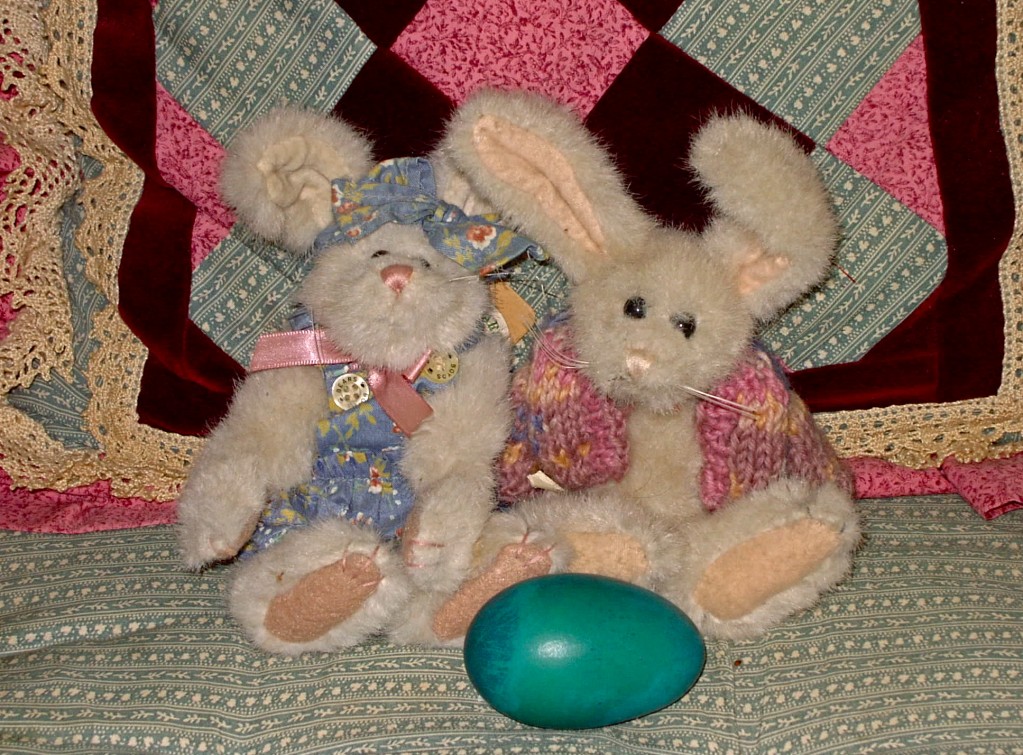
This is the best I could come up with this year; an egg is an egg is an egg, but my rabbits have been around a while, long enough to be a part of my Easter tradition. By the way, they are in no way responsible for the egg–I just liked it because it looks to be a double-yoker–and their names (which I didn’t realize when I got them) are Rose and Sara.
Sometimes you’re lucky enough to be reading something just when you need it. Or maybe it’s just that you read into it what you need to get out of it.
In The Black Monk, scholar and philosopher Andrey Vail’ich Kovrin, Master of Arts, is spending time with an old man and his daughter who place the orchard garden as the most important thing in the old man’s world, but whose high esteem for Kovrin allows him to encourage a marriage between his daughter and Kovrin as the least likely son-in-law to let the garden fall into disrepair and ruin after the old man’s death.
Kovrin is happy; he studies, he writes, he enjoys the beauty of the garden and he cares deeply for the old man and his daughter. He even tells her about a dream or memory of a legend of the black monk, though when it appears to him, he says nothing, fearing they will all think him mad. The monk convinces Kovrin that he is creative and a genius, and that he is one of the chosen few who are seek out the eternal truth through reason and beauty. Kovrin is able to enjoy all facets of his life until his wife notices him in discussion with the phantom monk and he is declared mentally diseased and treated with medications that dampen his whole being into mediocrity. A mediocrity, it is to be noted, that those around him happily accept, but which Kovrin finds abhorrent and soon he hates life and all those around him.
“Why, why do you make me have this cure? All sorts of bromatic preparations, idleness, warm baths, watching, poor-spirited, alarm for every mouthful, for every step–all this in the end will make a perfect idiot of me. I went mad, I had the mania of greatness, but for all that I was gay, healthy, and even happy; I was interesting and original. Now I have become more sober-minded and matter-of-fact, but in consequence, I am now like everybody else. I am mediocre, life is tiresome to me…”
Is the monk a metaphor for ego, self-confidence, creativity? So very much can be made of this simple story and its application to the social ways of the present. I wonder about the insistence that no one is superior, that we are all ‘special’; everyone is an artist, a writer, a poet. Often this is openly done by minimizing the value of the talented (many universities and high schools have dropped the valedictorian designation). Instead of setting higher standards of achievement, standards are lowered so that more people can claim achievement.
Even as Kovrin’s wife and father-in-law praised him, they did not manage to elevate his own self-esteem to the point of keeping him productive; the old man saw Kovrin more as insurance that his own accomplishments–the garden–would be safeguarded and maintained. The daughter saw him as a husband mentally and physically far superior to the local young men who wooed her.
I also find interesting Chekhov’s reference to the medications and means that are employed to change Kovrin’s mental state to one more ‘normal’ in their society. Kovrin realizes it has all dulled him into a mediocrity that is just like everyone else. Are we throwing this same water on the fires of creative difference of ideas by our insistence on drugs to combat what we’ve termed ADD or ADHD.
Are we, in our pursuit of equality and normalcy for all, turning ourselves into mere mediocrity?
You know, there’s nothing to compare to the old when it comes to story writing and someone such as Chekhov:
The gloomy pines, with their rough roots that but a year ago had seen him so young, joyful and hale, now did not whisper together, but stood motionless and dumb, just as if they did not recognize him.
There is a mood set here, a change of character, personification, imagery, tone. In this setting that Chekhov has placed his main character, we feel the changes as he recovers from what may have been madness in his hallucination of the black monk. Chekhov knows how to use setting to establish a base and then use it to involve the reader in its progression through the story.
Much different, maybe old-fashioned, but very satisfying in contrast to much of what is being touted as story these days.
Funny, a woman can come on so wild and free,
yet insist I don’t watch her undress, or watch her watch me,
then stand by my bed and shiver as if she were cold,
just to lay down beside me and touch me as if I were gold.
Thinking of Willie this morning, and how he’ll be right in Torrington this week. Made the decision not to put out the money for a ticket, just because of the economy and the still-real possibility of loss of income for us. How do people afford shows and dinners and trips and such? Job security? Money in the bank? Live for today attitude?
At any rate, I’m stuck in the shop today and listening for a while to Willie where he sings only to me for free and I’m caught once again in the lyrics of songs such as this because of their reality, their poignancy, their simple wonder at life and the things that mean something regardless of time or tyranny.
When, oh when, will Americans wise up and refuse to buy any more Chinese junk?
Knauf Drywall Fiasco Biggest Homes Defect Cast in U. S. History
My God, people, can’t we even make our own drywall anymore? It may cost more, but at least we wouldn’t be encouraging these ridiculous low wages for Chinese workers, we’d have jobs here in America where they’re desperately needed, and, according to a tv report just now, we wouldn’t be giving five year-olds emphysema.
Shades of The Road, Blind, and so many apocalyptic and disaster aftermath novels: More Squatters Call Foreclosures Home.
Now there’s something to this that could have been good, could have worked, like not forcing the real owners to leave to become homeless themselves, or groups working with banks and realtors to maintain the larger buildings and homes for the homeless rather than just moving people in on someone else’s misfortune. I especially like this:
MIAMI – When the woman who calls herself Queen Omega moved into a three-bedroom house here last December, she introduced herself to the neighbors, signed contracts for electricity and water and ordered an Internet connection.
What she did not tell anyone was that she had no legal right to be in the home.
An internet connection?
Or perhaps just with his character of Egor Semenych, an elderly man whose love of his garden is his life’s passion. Who worries that when he is dead, his garden will go to ruin, and even the idea of his daughter, Tania, taking it over does not console him:
She gets married, children arrive, and then there’s no time to think of the garden. What I chiefly fear is that she’ll get married to some young fellow, who’ll be stingy and will let the garden to some tradesman, and the whole place will go to the devil in the first year! In our business women are the scourge of God!
I take offense; I who start grapevines from snips of wood, cut thousands of peaches into desserts, turned stubborn raspberries into wine, make sauce, jelly and wine from the crabapples other people rake up and throw away, coaxed the rocklike quince into jewels of jelly.
Scourge of God indeed!
Well, at least the big bad corporations understand the unemployment and healthcare situation better than our government politicos: The Take Care Clinic at Wal-Marts offers “Free healthcare visits for our past, present, and future patients*, and their families, who lose their jobs and are uninsured.”
Screw worrying about insurance coverage; let’s give the people the help they really need and need now: medical services.
Laughter trills like water streams above the rock and mud of beds; love gets over itself. She shakes her hair back like she’s seen the models do; it’s not the same and yet for one fast beating of her heart, it works. She is young again, pre-love and in the atmosphere like rain.
Today, April 9th, is the birthday of my best girlfriend in high school, Pat, who married at twenty-one and has lived in TN almost since then. Just wished her a happy day via Facebook and then stopped and thought, gee, I too was born on the 9th, and then thought of Chris, gone almost five years now. Her birthday was October 9th. Then there’s Nancy, another long-term dear friend whose birthday is on the 10th–whoops! But understandable, since she takes her time and does things right. There were others that I’ve lost touch with, Kevin and Carol and Dick, all had something that clicked with something in me.
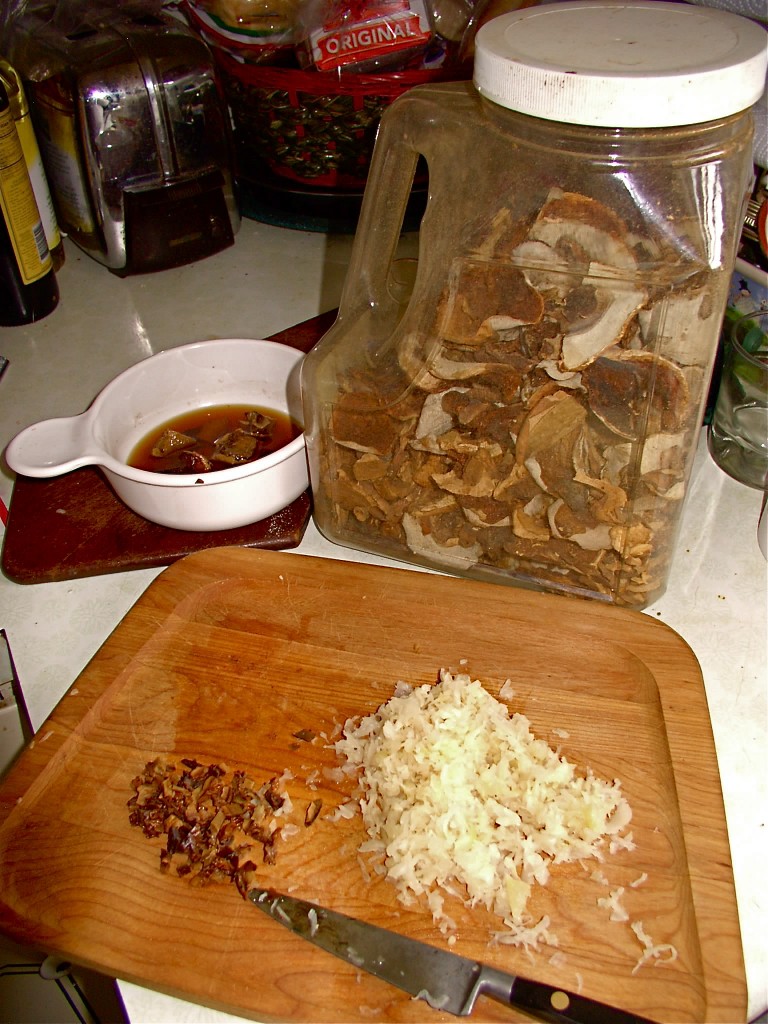 See the plastic jug? It’s filled with about $75.00′ worth of zypki–dried mushrooms–from the Black Forest and it’s a major ingredient in my traditional Easter. For baszcz, the white type as my family has always made it, as well as for the sauerkraut pierogi which I’m making here.
First you have to soften them a bit in boiling water, then chop them up along with the sauerkraut and fry in a bit of butter and seasoning. The sauerkraut ones are hard to make, as the filling doesn’t stick together neatly (that’s why I cut the sauerkraut up) as does the potato filling that I make with sharp cheddar cheese. I don’t do the potato/cottage cheese because I don’t like them as much.
Here I have the dough rolled out, 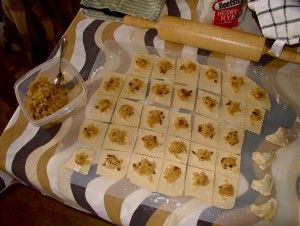 cut and a teaspoonful of filling plopped onto each square that will be folded into a triangle and sealed. The biggest pain in the neck is rolling out this elastic dough that defies all attempts to stretch without adding too much flour.
The dough I make has less eggs than noodle dough; five cups flour to two large eggs. But the idea is similar, and I make a large batch of meat-filled “Polish Ravioli” or “Italian Pierogi” and the difference is really that the ravioli dough is harder, tougher than what I make.
It’s always surprised me that much traditional ethnic cooking is very similar in many ways; pierogi-ravioli-wontons-empanadas. Polish Golabki are very similar to Greek stuffed grape leaves (which I’ve picked and used!), and noodles come in all languages.
The fun part of all holiday traditions is the food. The best part is family. While I don’t see mine much anymore, I’m glad that this recipe has been handed down to my nieces to take over for their own families. I learned to make pierogi from my girlfriend Pat when we were back in high school. Up till then, I think we used to buy them (no offense against my mother–I understand completely why she only made them a couple times). Then one year I made them with my aunt. Since then I’ve made them with my friend Fran, with my sister Andrea, and with my niece Erica so that hopefully, I can reach my golden years without having to make the damn things.
More poetry from Jesse Abbot and this particular piece crosses the border into prose. I like it.
I’ve always wondered (and should study up on it or get into a poetry group) what makes prose into poetry. I’m a lover of the poetical use of words in narrative, yet was surprised several years ago to find pieces that I considered short story or essay be included under the realm of poetry (whoops, I first wrote “form of poetry” there, and that’s a wide open field).
But art is freedom–once the rules are known and understood, they are meant to be pushed beyond their boundaries and may, as in the case of prose poetry, merge with a different genre to become something new. After all, if one appreciates the poetics in story form, then one will well appreciate the story form of poetry.
Irrational Fears
Not born of sheltered privilege,
nor pearl abused by father, brother,
mustachioed hardened uncle,
or a mother pecked by a pelican
in her ninth month of bearing,
or borne by ghosts and grown
in rooms dark for lack of payment
for the light, or innocent delight
at warm and furry rats
jumping, playing games of tag
within the confines of her quilt,
but something, something left
a widget in her mind
of this: a very real and shaking fear
of melting in the rain
Thin of frame and dancing feet and
slick yellow duck-like wear
protected her till she, a modern maid
laughed and yet stayed wary,
but there comes a time when luck
runs thin and thinner
to a trickle and a stop and catches
all the fears and flicks the sun off
in a flash and taken by surprise
the clouds mumble, race about
and lost, they hover, fold,
and cry–
yes, cry
in all the horrible
treachery of rain.
What could she do?
but bravely stood and faced it
shuddering within its cold embrace
felt its lover’s hands urge,
stimulate and beckon her,
bring her up to meet it
in a whirlwind wet and free
joyously she embraced it
turned her face up to the source
laughed at conquered danger as
on her tongue she caught
the silver drops of life
with head thrown back
in wanton ecstacy.
How could she have known
the cruelness of the darkest dreams
was not in the acknowledged power
but that of which
she had not thought, and
ere she could fully recognize
the true and tempting adversary
of all the years of dreaming
she had drowned.
Looking around for some quick short class setups for web design, code, digital art, and some specific software instruction (Tinderbox, In-Design, etc.) to maybe speed up my learning process here. It seems to take me forever to logic out a process on my own until I break down and bug somebody when I can’t come to or find via research the answers myself. And while I still have a few good years left in me, I realistically don’t have a lifetime ahead of me either. Wish I could just plop myself into a random but relative classroom seat, or be invisible and pop in without anyone knowing I’m there.
 The Lost Children: A Charity Anthology