
LITERATURE: : The BW Life of Oscar Wao – History and Voice

As we move through this chapter on Beli (Oscar’s mother) as a young girl in Santo Domingo, there is a preponderance of background and history woven in, about a country in upheaval under a cruel regime. This, I believe, along with the footnotes of further explanation, is a large part of why this novel won the Pulitzer Prize, National Book Critics Circle Award for Fiction, and a number of other awards.  The manner in which Diaz handles the atrocity and the interaction of the family and town within that environment is a bit reminiscent of Marquez’s 100 Years of Solitude where there are battles on the homefront within a small arena that are just a part of the big picture.

There is also the narrative voice which is no-frills and yet sprinkled consistently with Spanish words that seem to act as a focus and a single-word often encompasses the tone of the story. The voice is one of whispered gossip, or memory, a tale that is told as a matter of fact; a matter of history.

She should have kept running too but she beelined for home instead. Can you believe it? Like everybody in this damn story, she underestimated the depth of the shit she was in. (p. 142)

Diaz breaks through the fourth wall with this writing, inviting the reader to agree with the narrator in his own assessment of the story. He tells it as if he’s in sympathy with the reader and himself cannot understand the actions of his characters.
Posted in LITERATURE | Tagged | Comments Off on LITERATURE: : The BW Life of Oscar Wao – History and Voice

WRITING: Encouragement

In the middle of dinner preparations a niece, the youngest of them all, calls to thank me for framing a drawing and poem she'd composed a while ago. She's shy, hardly knows us that well, but I sense a pride in her work being framed and displayed.

Well, you write very well, I say, do you enjoy it? A happy "yes" is her answer. Then keep writing, I tell her, keep writing stories and poems and whatever you like.

Sitting back down, opening Pages, I type a few words, smile and then frown. What have I done to this innocent child?

Posted in WRITING | Comments Off on WRITING: Encouragement

REALITY?: Happy Thanksgiving to You All!

112708r
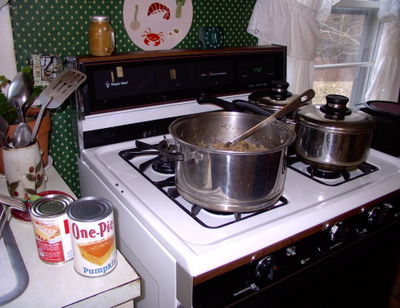
Everyone else has pictures of the turkey brown and crisp, pies still hot and aromatic, a groaning board of table spread out in white linen with the fine china and silver and complete with napkin rings and individual salt shakers, but I chose to give the reality of Thanksgiving; the work preparations.  Besides, I’ve gotten a late start this morning.

We’ll be missing family and the tables snugged together to fit seventeen people, but to be honest, I’m getting used to the quiet peace of unhurried holidays. The pies can be baked later, once the turkey’s being digested and before the leftovers are hauled out again for a late supper. Pumpkin and apple, maybe a cherry one too. Friends and family come for this after-dinner-dinner and this year, they may get the chance to watch vanilla ice cream melt into the still-warm and great-smelling apple pie in a bowl.

Best wishes to all for a happy, healthy, and loving holiday.

Posted in REALITY | 2 Comments

LITERATURE: The BW Life of Oscar Wao – Lost in Translation

While it likely assists to establish the voice, the frequent use of Spanish words within the text are starting to annoy me. When I read, I like to get into the movement of the story and while I can remember or guess at many of the meanings, I find myself unwilling to go look up the ones I do not recognize. To top it off, of the two sites I use for translation, one is screwed up with a Circuit City ad and refuses to translate, and the other doesn't know most of the words.

La Inca assumed that because Beli had of late not shown any enthusiasm for the bakery or school or for cleaning she'd devolved into a zangana. But she'd forgotten that our girl had been a criada in her first life; for half her years she'd know nothing but work. (p. 104)

Now it's easy enough to skim over these and get the drift, but between these and the frequency of long footnotes establishing some background history of the country and the politics, I find the halting of the story too intrusive and have taken to ignore them.

Not a great policy for one dedicated to close reading.

Posted in LITERATURE | Tagged | Comments Off on LITERATURE: The BW Life of Oscar Wao – Lost in Translation

REALITY?: Thankful

112608I try to be grateful for something every day, but I’m an up-and-down sort of folk and sometimes need reminders.

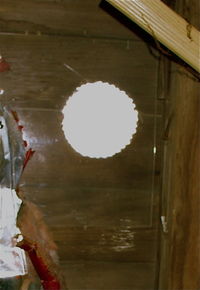
With the new propane stove, I was able to remove the stovepipe I’d put through the barn wall, covering it with a piece of plexiglass and enjoying the new porthole window. But there’s a constant reminder of my Dad here; note the rough edges of the circumference made by the drilling of holes in a circle, then cutting through hole to hole with a small sawblade. He taught me that.

Maybe the holes were a little close, but it’s inch-thick siding I went through. The stovepipe was held upright outside with two thin strips of aluminum, nailed to the wall. My neighbor, gone ten years now, laughed and said (he being an architect) that it wouldn’t stand up to the winds. I had a hard time pulling them off the other day.

I miss them both.

Posted in REALITY | Comments Off on REALITY?: Thankful

LITERATURE: The BW Life of Oscar Wao – Plot

Clearly nonlinear, we go back in time rather than forward with each chapter, marked with dates (years) covered. Junot Diaz jumps from time periods with focus on a different character in each chapter, from Oscar, to his sister Lola, and now to their mother, Beli.  What is interesting is that we find something new about the characters by the different perspectives, and in particular, where Lola's problems with her mother appeared to make her mother into a monster, where Diaz has left us in chapter two leads into an answer that surprises us. Here, at the end of Chapter 2, Lola is listening to her abuela talk of Lola's mother.

She was about to say something else and then she stopped. And that's when it hit with the force of a hurricane. The feeling. I stood, straight up, the way my mother always wanted me to stand up. My abuela was sitting there, forlorn, trying to cobble together the right words and I could not move or breathe. I felt like I always did at the last seconds of a race, when I was sure that I was going to explode. She was about to say something and I was waiting for whatever she was going to tell me. I was waiting to begin. (p. 75)

After some description of Beli's life with her aunt–we find that she was an orphan, and her aunt was 'mother' to her–we begin to see a different image of Beli. But here is what we believe has disturbed Lola at the telling:

Beli, clearly: one of those Oya-souls, always turning, allergic to tranquilidad. (…) Our girl had it made, and yet it did not feel so in her heart. For reasons she only dimly understood, by the time of our narrative, Beli could not abide working at the bakery or being the "daughter" of one of the "most upstanding women in Bani." She could not abide, period. (p. 79)

What is likely frightening to Lola as she hears her abeula's story, is that her restlessness, her spirit, her senses, are so very much like the mother she shuns.

Posted in LITERATURE | Tagged | Comments Off on LITERATURE: The BW Life of Oscar Wao – Plot

LITERATURE: Neruda’s Ode to Criticism

Neruda finds beauty in the act of critique:

I touched my book:
it was
compact,
solid,
arched
like a white ship,
half open
like a new rose,
it was
to my eyes
a mill,
from each page
of my book
sprouted the flower of bread;
I was blinded by my own rays
I was insufferably
self-satisfied,
my feet left the ground
and I was walking
on clouds,
and then,
comrade criticism,
you brought me down
to earth,
a single word
showed me suddenly
how much I had left undone,
how far I could go
with my strength and tenderness,
sail with the ship of my song.  (p. 185)

Neruda shows us how powerful ego can overcome our better judgment with physical images of both strength ("Like a white ship") and beauty ("like a new rose"). By comparing a simple open book with these images, he shows us how blind we can be to our own work.

Neruda brings in the image also of the book "sprouted the flower of bread," as if to say that not only are the words something created, but are meant to provide sustenance to their readers. He goes on to extol the virtues of additional experience added into one's own, to expand (perhaps grow, like yeast bread) the meaning of the words to make it more relative and develop a stronger impact.  And I love the ending:

With a single life
I will not learn enough.

With the light of other lives,
many lives will live in my song. (p. 189)

Posted in LITERATURE | Tagged | Comments Off on LITERATURE: Neruda’s Ode to Criticism

LITERATURE: The Organization Tumbleth

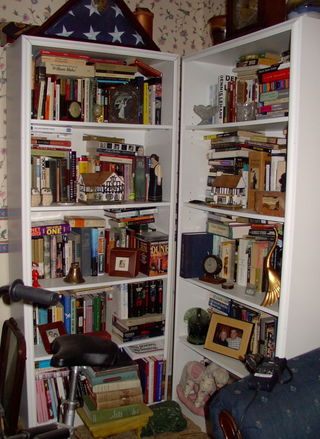
Well, the shelves were a great improvement over the books stacked on the hearth, but my neatly organized book collection has suffered from the acquisitions since.
112408l

Posted in LITERATURE | Comments Off on LITERATURE: The Organization Tumbleth

LITERATURE: The BW Life of Oscar Wao – Voice and Character

Junot Diaz has a nice sense of his characters. With Oscar, we feel his struggle between his growing natural interest in girls compounded by peer pressure and his need to hold onto the part of himself that he knows is true.

When we get to Lola, we see a passionate need for release from responsibility and a desperate grasp for self esteem, her mother having dumped on her the former while hacking away at the latter. There is a language that Diaz uses with Lola that is both bitter yet hopeful.

It's about that crazy feeling that started this whole mess, the bruja feeling that comes singing out of my bones, that takes hold of me the way blood seizes cotton. (p. 72)

We get a feeling of movement, "singing out of my bones" and "the way blood seizes cotton."  With this single sentence, Diaz demonstrates the anxiety of Lola's life, the push and pull that carries her through her days.

Posted in LITERATURE | Tagged | Comments Off on LITERATURE: The BW Life of Oscar Wao – Voice and Character

LITERATURE: The BW Life of Oscar Wao – Changing Perspective

While Oscar was the protagonist in the third-person pov of the first chapter, and we followed him from adolescence through his going away to college, Diaz switches us to first person pov of Oscar's sister Lola without warning in the second chapter. But then, that's what chapters are for; to designate a change of time, place, or character.

We've already been introduced to Lola and we see her as basically a caring older sister, encouraging and teasing the nerdy Oscar in his relationships. At school she seemed to be considered cool and Oscar holds her in high regard. But with the switch to Lola, we see a very different home life for her and Oscar. Even while discounting some of the usual mother-daughter misunderstandings, Lola claims to be mentally and emotionally abused by her mother, something that we didn't get the feel of from Oscar's story.

This reminds me a bit of Matthew Sharpe's Jamestown, where we get several perspectives of the same events from the different characters. It's a nice element in writing that allows the reader to make a better assessment of the environment by balancing out the different viewpoints. It also allows the reader to get a better feel of the characters by how they present their versions.

What we see of Lola's character is grit and determination, rebellion and strength; a much stronger player than the nurturing older sister we've come to know.

Posted in LITERATURE | Tagged | Comments Off on LITERATURE: The BW Life of Oscar Wao – Changing Perspective

LITERATURE: More on Neruda’s Ode to The Past

Well that was an astute review of the piece below: Wow. Let's see if I can be a bit more specific.

The language (at least in translation) is simple and direct. Neruda uses a metaphor for time as two rivers, the past flowing backward, the other flowing forward, though moving with you. So this is not the future precisely, but the possibilities ahead. The present is that "single second they may be joined." The imagery of the river is a bit more powerful than I picture in reading this passage. I imagined a quick-running stream, where I could visualize my bare feet on the rockbed, the water towards me in one direction only, yet where it splashes against my legs, it springs forward before it falls back into the water. That, I see, as that "drop of an instant."

While my interpretation doesn't follow Neruda's two rivers, both in size and direction of flow, I would likely note attitude and experience influence the image. In this case, I see myself walking upstream, not necessarily fighting the flow, but rather seeking its source. Personally, I'm not a strong swimmer and that's probably why I made the rivers into streams, feeling more secure and able to navigate my way.

Neruda makes a point of the instant the present becomes the past: "Now. This is that moment, the drop of an instant that washes away the past. It is the present." What a wonderful image. A "drop" of a riverful of water; as I type this it just became something I've typed.  "Racing, slipping."

There is no regret in Neruda's poetic assessment; there is hope and instruction to use time with love and care. "Time that flows will have the shape and sound of a guitar," he says. Here I listen for the hum of life, the natural sounds that include silence as a song.

Neruda leaves us with this: "Time is joy.

Posted in LITERATURE | Tagged | Comments Off on LITERATURE: More on Neruda’s Ode to The Past

LITERATURE: Pablo Neruda: Ode to the Past

I am a firm believer that besides the different genres and classic masters, every would-be writer should keep as well a book of poetry beside the couch. For learning imagery, brevity, rhythm, there is nothing that matches the lines of a poem to create a mindset that brings these elements into our writing.

I do not intend to start Neruda at page one and follow in a linear fashion, but rather flip the book open to see what catches my soul.

Time
is divided
into two rivers:
one
flows backward, devouring
life already lived;
the other
moves forward with you
exposing
your life.
For a single second
they may be joined.
Now.
This is that moment,
the drop of an instant
that washes away the past.
(Ode to the Past, p. 115)

Wow.

Posted in LITERATURE | Tagged | 1 Comment

LITERATURE: The Brief Wondrous Life of Oscar Wao – Opening Thoughts

I've been busily writing on Hypercompendia so I haven't been as caught up as usual here on the literature postings but I have starting reading this novel by Junot Diaz and find it to be rather quick, easy reading despite some halts over the Spanish words with which the story is graced.

Not sure why I've been into adolescent boys lately–in my reading, that is–but this is another and yet it is so different than the rest perhaps because this boy is not a hero, but more the geeky pimply-faced and overweight typical teen. 

Oscar goes through his awkward stage determined to not adjust to his peers, but take the opposite approach and stand out as different. Though he attempts to work on his physical appearance, his interests are sacrosanct.

Oscar listened to their messages on the machine and resisted the urge to run over to their places. Didn't see them but once, twice a week. Focused on his writing. Those were some fucking lonely weeks when all he had were his games, his books, and his words. (p. 32)

He gains some respect from his older sister as he stands up for himself:

In the old days when his so-called friends would hurt him or drag his trust through the mud he always crawled voluntarily back into the abuse, our of fear and loneliness, something he'd always hated himself for, but not this time. If there existed in his high school years any one moment he took pride in it was clearly this one. (p. 33)

So Oscar learns early how to escape peer pressure, that pox on adolescence that leaves its marks on lesser souls. It is clearly one of the hardest lessons one learns in life, and some people never escape it. There is a need to be included, and yet the alternative is just as satisfying, often more so. As long as one becomes "unique" for a good reason rather than for antisocial behavior, usually those who once shunned such an individual come to admire him.

Diaz's writing style reveals a very strong voice that sets the tone and mood of the story. There is a casual language that includes expletives and politically incorrect labels and yet it, as with Twain's Adventures of Huckleberry Finn, belongs because it is used in innocence of its politically incorrectness. Language changes within society's norms. What once meant nothing demeaning, may become offensive. But it is not only time that changes meaning, but culture and often racially charged words may still be acceptable within its own marked group.

Posted in LITERATURE | Tagged | Comments Off on LITERATURE: The Brief Wondrous Life of Oscar Wao – Opening Thoughts

REALITY?: A good, good day.

With every down, there's an eventual up. Today brought three uppers to keep me floating above the swamps of human despair (sorry, it's just the mood taking over the language).

1. The free gas range is likely still usable though it's been up and down on the question more than the stock market slides. The range is "unique" in that even with a sealed burner system, the top lifts up to make adjustments so no converter kit is needed. Which is a good thing since none were available.

2. Got an appointment set up for a job possibility (some time in the future) working with kids and computers. (Note to Steve: Uh, maybe I shouldn't have been so flippant about filling out that Hypertext 08 bio)

3.  El esposo survived the layoffs so far.

Posted in REALITY | 3 Comments

WRITING: Moral Support

How funny; waking with story, coffee and the Mac at the ready. Clicking on Pages and watching as the inkpot icon jumps up and down with glee on the dock. She's going to do it! it says. She's going to write!

Posted in WRITING | Comments Off on WRITING: Moral Support