LITERATURE: Black Swan Green – Simile

A little gem:

(Talking with some people’s like moving up higher screens in a computer game.) (p. 158)

I believe Jason’s referring to his growing relationship with Madame Crommelynck, but since he has just described his parents’ current state to her, it may as well be a reference to theirs.  What’s so neat though is the comparison Mitchell has Jason using, of the nature of man and his means of communicating to the technology of computer gaming which is, after all, a simile of reality.

Posted in LITERATURE | Tagged | Comments Off on LITERATURE: Black Swan Green – Simile

REALITY?: Long, long day

Can you tell that my left breast is now smaller than my right?  Of course not; you couldn’t tell when it was a silly millimeter larger so why would you now?  Biopsy report is expected to be fine and the very very sweet young Chinese doctor made the whole thing a much more pleasant experience than it could have been.  I told him that he was as good as my dentist with the numbifier needle.

Then off to the attorney–a good attorney, a nice one who unfortunately couldn’t represent me in the recent past but wouldn’t have allowed it to drag out three years.  We decided it was high time we had wills drawn up and things like poa’s and living wills.  In case I turn into a breathing avocado some day.

Last but the bestest fun, a great b.s. session with the writers group where we laughed more than we discussed the elements of story so the day ended on upbeat from a pretty crappy start. 

Tomorrow’s scheduled to be sunny and hot.

Posted in REALITY | 4 Comments

LITERATURE: Black Swan Green – A Touch of Philosophy

I love this, it’s as representative of the thought process of children, in carrying an idea a step further and further until it becomes another question of sorts, while at the same time, it is a worldly view and comment on life and death, and a perspective of time and space:

The sequence of doors we passed made me think of all the rooms of my past and future.  The hospital ward I was born in, classrooms, tents, churches, offices, hotels, museums, nursing homes, the room I’ll die in.  (Has it been built yet?)  Cars’re rooms.  So are woods.  Skies’re ceilings.  Distances’re walls.  Wombs’re rooms made of mothers.  Graves’re rooms made of soil.  (p. 151)

There is a logical progression of states from life to death, the hospital ward through life’s ‘places’ all the way to a place to die.  I love the way Mitchell makes the circuit and brings the end (death) into the future by asking if the room has been built yet. 

I like the expansion of space bounded by walls into arenas of open space.  The idea of distance being a wall is thought provoking and changes the whole meaning of traveling or escape by leaving.  The best: "wombs’re rooms made of mothers." which goes back to birth and ends with "graves’re rooms made of soil" that encompasses the span of a life.

Nice stuff.

Posted in LITERATURE | Tagged | 2 Comments

LITERATURE: Black Swan Green – Technique

A couple of real nice exposures of change of attitude and time by Mitchell, keeping the descriptions fairly close yet far enough apart to denote a difference in Jason’s first and second visits to Madame Crommelynck:

Inside smelt of liver and soil.  A velvet staircase sliced sunlight across the hall.  A blue guitar rested on a sort of Turkish chair.  A bare lady in a punt drifted on a lake of water lilies in a gold frame.  The "solarium" sounded ace. (p. 143)

Jason and the Madame discuss poetry and the term beauty.  She is demanding of one thing from him, that he speak what’s on his mind and say it honestly.  On his second visit, this is his description of her home:

The stairway needed fixing.  A knacked blue guitar’d been left on a broken stool.  In a gaudy from a shivery woman sprawled in a punt on a clogged pond.  Once again, the butler led me to the solarium.  (I looked "solarium" up.  It just means "an airy room." (p. 151)

The mystery of the visit, the anticipation, has been taken away after the first meeting has established the woman’s interest in his poems.  Oddly, he does away with his lyrical description and replaces it with a more honest view, doing just as the woman had suggested as far as overdoing the elaborate use of adjectives for imagery.

And here’s another goodie:

I’d got ‘The Old Man and the Sea’ by Ernest Hemingway from the school library, just ’cause Madame Crommelynck’d mentioned him.  (The introduction said the book’d made Americans burst into tears when it was read on the radio.  But it’s just about an old guy catching a monster sardine.  If Americans cry at tht, they’ll cry at anything.) (p. 151)

We’re seeing an immediate influence on Jason, a change coming about as he is recognized as a poet–something no one else knows since he uses a pseudonym and the poetry is being published locally by the vicarage.  But the old woman has been reading the poems and forwarding them on, and has evidently seen something in Jason worth nurturing.

Posted in LITERATURE | Tagged | Comments Off on LITERATURE: Black Swan Green – Technique

REALITY?: Growing Season

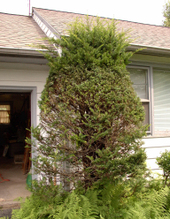
So here’s why short people should not be let loose with hedgetrimmers. 072708r
Actually, I ended up getting a ladder to finish the top of this one and a couple others.

In truth, these shrubs are going to have to go.  Everything’s just getting overgrown particularly since the last couple of years I was in such a dither that I was totally unproductive and really didn’t care if it turned into jungle out there.  There’s several small bushes around that ended up underneath their faster growing siblings so those will be dug up and moved to the front.  And, since I feel these are all getting pulled out anyway, don’t tell anyone, but for the first time I took the electric trimmers to the rhododendrens.  And this, after yelling at my husband eighteen years ago for doing the same thing.  I told him they had to be “artistically hand-pruned” which is why he’s left them to me to take care of ever since.

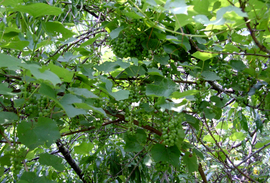
It’s going to be a bumper crop, just look:
072708r2 The grapes have glommed onto the peach trees and it’s such a tangled mess that every time I go to chop them off or cut the peach trees down I tell myself that since they’re doing great, I’ll fix things next year.  That’s how the peach trees got to be so big so fast, and how the grapvines have taken over.

I can smell the jelly simmering and hear the wine bubbling by early to mid September.

Posted in REALITY | 2 Comments

LITERATURE: Promise of Rain – Master of Subtlety

Wow.  Just caught the drift of Taylor’s genius at showing character.  In using the first person pov of the father describing his relationship with his son, there is an unreliability about the narrator not necessarily that he is hiding something within his words–that’s there too–but that his perception of the his son is way off from what we are experiencing.

The final pages here, the same scenario of Hugh desperately hoping for rain so that his reading will be broadcast instead of the game.  The sun disappears and a crash of thunder brings the anticipation to a resolution:

Hugh galloped across the hall into the living room and commenced disconnecting the batteries from the charger and hooking them up to the radio.  The rest of us followed, just as if there were no other room in the house we could have gone to. 

Why this wording? Why do they think they need to pretend? They should have been leaping in glee for Hugh!

Through the loudspeaker the voice of Hugh Robert Perkins began with some introductory remarks…

Here the father refers to his son as Hugh Robert Perkins; this directly relates to Hugh’s often referring to his parents by their formal names and we wonder why the father has chosen this way of putting it.

Hugh never once looked around from the radio(…) The storm and static got worse every second and he didn’t even try to improve the reception.

Hugh was listening closely, as he expected his family would be doing.

Toward the very end, I saw his mother raise her eyebrows and tighten her mouth the way she does when she’s about to cry, and I shook my head vigorously at her, forbidding it.  I knew what she was feeling well enough; we were all feeling it: Poor boy had endured uncertainty, had for days been pinning his hopes on the chance of rain, and now had to hear himself drowned out by the static on our old radio.  I thought it might be more than flesh and blood could bear.

Not only does the father assume that everyone is feeling sorry for the boy, and that Hugh is embarrassed and upset–about which he turns out to be wrong–he dissuades his wife from sympathizing with what even he considers a tough thing to go through.

When Hugh jumps up in excitement at the end of the reading, the father realizes that Hugh somehow heard it all and was proud, not embarrassed. He also feels the growing gap between them.  Hugh sees it too, and as always, he puts himself down likely because to do so keeps his father from doing it.

We see the separation as Hugh grants himself the freedom from the burden of his family’s expectations.  I am thinking that what Hugh was searching for in the mirrors was not how handsome or whatever he was, but what was wrong with him that didn’t measure up. 

The final paragraph is the most telling of the story. The narrator didn’t get it and he never will. The irony of the last statement and the narrator’s assessment of the nature of the episode and relationships is priceless.

Posted in LITERATURE | Tagged | 2 Comments

LITERATURE: Promise of Rain – More on 1st Person Narrator

This just makes you want to slap him hard:

After raining all morning, the skies seemed to be clearing.  It was mostly bright while we sat there, with only an occasional dark interval.  During those dark intervals, Hugh ate feverishly; otherwise he only picked at his food.  I’m afraid that with the rst of us the reverse was true.  (p. 113)

How telling of the narrator, Hugh’s father, that even as he and the rest of the family are aware of Hugh’s wish that the rain at least stall the start of the game so that the radio station will play his talk, he still hopes for the game to begin on time.

Lucy may, their black servant has stepped behind Hugh as the sun shines through the window on his back in a protective gesture, understanding that he is hurting.  She dismisses the chirp of a bird as a sign of a promise of rain and tells him so quietly.  But the father has overheard.

Hugh may or may not have heard the redbird.  But he paid no more attention to Lucy May’s encouraging words than he had to the encouragement and applause of Miss Arrowood. (p. 113)

The father takes a swipe at his son here, failing to understand that Hugh may not care what these other people think; his life has been spent to this moment trying to make his family recognize him for something. 

I’m wondering though how far off his father’s estimation of his son has been; if in fact despite his apologetic recital of the situation and of his son’s escapades, he does not instead blame himself for not giving him the benefit of education the others received.  If the fact that his own business left him without as much to provide for Hugh as the older children, is what he is really ashamed for and is transferring the differences onto Hugh rather than admit his own failings.

Posted in LITERATURE | Tagged | Comments Off on LITERATURE: Promise of Rain – More on 1st Person Narrator

LITERATURE: Promise of Rain – Taylor’s Unreliable Narrator

There are similarities between Peter Taylor’s stories in the first person pov and Raymond Carver’s Cathedral. What has become prominent for me is the way he handles the narrator’s evaluation of another character’s actions.  There is an underlying theme that is quite contrary to the words the narrator speaks.

In Promise of Rain, the narrator describes a frustration with his youngest son who in his opinion is very different than his siblings in ways that embarrass the father.  Hugh is goodlooking and has a habit of studying himself in mirrors.  He is also less ambitious than the others–whose ambition often has merely been marrying well.  He bounces from one thing to another in trying to find himself, and actiing, above schoolwork, may be one thing that suits him.  In the pursuit of improving himself, he has been practicing elocution and the father describes how Hugh is anxiously watching the weather and recharging old radio batteries in the hope that a local game will be called because of rain and the station will instead play a ten minute speech by Hugh as a local service.  The father, on the other hand, is looking forward to hearing the game.

I knew why Hugh kept looking out the windows, and soon I was looking out windows, too.  The rain came down pretty steady all morning and only began to let up about noon.  I found I was pitting my hopes against his.  I was, at least, until I saw how awfully worked up the boy was.  Than I tried my best to hope with him.  But I don’t think I ever before had such mixed feelings about so small a thing as whether or not a ball game would be rained out.  (p. 112)

What the narrator is saying that as a father he switched from his own hopes to hear the game to ‘try’ his best to hope for the opposite for his son’s sake.  What’s particularly telling is his statement that he"had such mixed feelings about so small a thing as" whether the game would be rained out!  He doesn’t say a big thing like his son’s talk on the radio, but refers to the ball game instead.

There are many instances where the narrator says something that can be taken sarcastically, or condescendingly, and puts himself in a position of trying his best for the boy but continually being disappointed.  Hugh is bright and remains cheerful, and often we get the idea that his father is misreading him badly.  But what comes through even stronger, to me, is that the narrator is not telling us how he really feels.

Posted in LITERATURE | Tagged | Comments Off on LITERATURE: Promise of Rain – Taylor’s Unreliable Narrator

LITERATURE: Black Swan Green – Metaphor & Pacing

There is an underlying theme to this novel, and that is the war in the Falklands that has affected England and comes home to Jason with the death in combat of the older brother of a friend. The ongoing war is also an indicator of Jason’s maturing as his interests change from boyhood play to girls, and war, and death, and sex, and his enlarging the world around him by studying it more closely.

Mitchell seems to challenge his protagonist in ways that teach him about people. Each chapter is linear in time, but each brings in an episode that differs from the others in installing a new hurdle of sorts for him to overcome or digest and evaluate.  The episodes tie in in subtle ways; Jason’s view of a young couple having sex under a tree in which he’s hiding gives him an indication of male/female relationships.  This, against the growing discontent between his father and mother–likely over a suspected affair that has been foreshadowed beautifully in the opening of the story–has him questioning the changes between young love and years of marriage. 

In the chapter I’ve just finished, Jason is taking a long walk through the outskirts of town to investigate a mysterious underground tunnel.  For me, it serves as a metaphor for this particular stage in his life between adolescence and manhood.  What he encounters along the way are surely representative of life’s own curves and walls to climb around or over.

Posted in LITERATURE | Tagged | 2 Comments

LITERATURE: Black Swan Green – Nice Stuff

A few nice phrases used to establish an unspoken fact.  Here, the common knowledge of Moran’s father being an alcoholic, yet the way it is handled carefully by others:

"Does your old man ever get pissed? Moran asked.
If I said yes I’d be lying, but if I said no it’d look day.  "He has a drink or two, when my Uncle Brian visits."
"Not a drink or two.  I mean does he get so fucking plastered he. . . he can hardly speak?"
"No."
That ‘no’ turned the three feet between us into three miles.  (p. 80)

And here, where Jason is taken by Dawn Madden as the first girl he’s interested in, and the subtle manner (yet bold, since it is merely a repetition) that Mitchell shows it.

"Madden!"
Her stare said, What?  Dawn Madden’s eyes are dark honey.
"That could’ve stuck right into me!"

Dawn Madden’s eyes are dark honey.  "Oh, poor Taylor."  (p. 84)


Posted in LITERATURE | Tagged | Comments Off on LITERATURE: Black Swan Green – Nice Stuff

LITERATURE: As a Sign of the Times

As I was reading Peter Taylor’s story The Old Forest, I read an interesting post by Mary Ellen about her frustration with Hemingway’s characterization of women (and other points she takes issue with as far as Hemingway’s writing).

How and for what purpose is a so-named "classic" included in academic required reading? No doubt that Hemingway was a giant, but what is his staying power and how long before contemporary works are added to the agenda? Need Hemingway be ‘replaced’ for his seemingly macho heroes and a lifestyle that is thankfully (in many ways) gone?  Or is it a record as telling as history lessons; literature teaches us much about what people were reading–or were not being allowed to read, as well as often a spoof of the times (think Candide) that exaggerated the social problems of the day.

Interesting thoughts for the literature teachers of tomorrow to consider.

Posted in LITERATURE | Comments Off on LITERATURE: As a Sign of the Times

LITERATURE: The Old Forest – Moral

Just finished Peter Taylor’s story The Old Forest and I understand that the theme is one of how people treat one another, and how change comes slowly. 

There is a friendly tone to Taylor’s first person narrator and in the reminiscence of the event of the automobile accident which brought the comparison of lifestyles and in particular, of woman’s place in society, he is telling us what he has learned from it.  There is a wistfulness in his voice, as if he wishes he could have understood it all better and more, that society had understood the strength of women and brought it to its fruition rather than sidestepping it into an almost cunningness rather than recognize its value.  He understands that even as she had explained it all back then, his fiancee–now his wife–still has not broken free from the role she was given at birth. 

Nice writing–though as I said, a bit dated in its overinvolvement of language to tell a simple story.  The underlying them of equality of gender was strong throughout and almost anticlimactic once the answers to the mysteries are given.

Posted in LITERATURE | Tagged | Comments Off on LITERATURE: The Old Forest – Moral

REALITY?: Of Gardens and Nature

Mother Rabbit rolls joyfully in the sand where once the pool sat; life has changed. Spotting me, she glares; I’ve closed the gates with chickenwire around the peas she’s pointed out to progeny and lettuce she was waiting for to ripen.  Zucchini finally blossoms; yellow faces smiling once they see the danger gone.

And after eighteen years I finally find a cardinal feather fallen from a bright red wing.

Posted in REALITY | Comments Off on REALITY?: Of Gardens and Nature

LITERATURE: The Old Forest – Making a Statement

Forty pages into this particular story and I’ve learned this: A young man has been caught with having had a girl other than his fiancee in his car a week before his wedding, as they’ve had an automobile accident.  The girl took off through the woods immediately following the collision and is missing now for several days.

The time of the telling is a past reflection; the narrator has gone ahead and married his fiancee despite his worries at the time that the incident may have changed her mind.  We’re not sure however, that the girl who was with him has survived the winter storm in the woods.  Everyone is secretive. 

But the real story here appears to be the difference in the two women as to social status, and in particular, how the men of the story view them.  There is (to my mind) too much emphasis placed on this point, almost a "methinks (s)he doth protest too much" attitude in protecting the reputation of this missing girl, and the focus on who is marriage material and who is not; even as all are almost condescendingly protective.

The conflict started with the accident; the tension continues with the possibility of his broken engagement–although he sees his fiancee as quite mature and understanding, and the question of why the girl has taken off, and of course, if she is safe.  But the majority of words have been spent on the narrator’s explanation of how women were considered back in the 40s and their social standing not only in the South, but in the area of their male counterparts as well as the women of other groupings.

A bit much; I think it might have been more briefly told.

Posted in LITERATURE | Tagged | Comments Off on LITERATURE: The Old Forest – Making a Statement

WRITING: Setting Mood

Last night’s rain falls long after
it has traveled on to more exotic scenes
telling morning stories of the
deer out seeking greener grass
each step a waterfall
as pelts brush by soft leaves
that cup the weather,
and cottonwoods in the slightest breeze
toss out the dregs of drink
they hailed last night;
clouds pull back like
bedclothes for the earth to waken
and the sun peers out to see
if it should rise.

Posted in WRITING | Comments Off on WRITING: Setting Mood