LITERATURE: Confessions – Belief

Augustine tells us of the reasoning for when he (and as he suggests, others) come to dwell on the Bible and the word of God, as opposed to avoidance even when a basis for belief is acknowledged.

I therefore decided to give attention to the holy scriptures and to find out what they were like.  And this is what met me: something neither open to the proud nor laid bare to mere children; a text lowly to the beginner but, on further reading, of mountainous difficulty enveloped in mysteries.  I was not in any state to be able to enter that, or bow my head to climb its steps.  What I am now saying did not then enter my mind when I gave my attention to the scripture.  It seemed to me unworthy in comparison with the dignity of Cicero. (III.9)

Simple truth rendered without eloquence, or the status of the poets and philosophers then, and not appealing to the mind of one taken by earthly measures.

It is sometimes difficult, as if repelling to the unready mind, to read Augustine’s intimate reflections as they are told to–not the reader, but–God.  One’s own belief is brought into focus as if a religious God is in question, then the narrator of this, Augustine, is in question too as to credibility. 

There are faiths that are so strong and daily fed at both ends of the spectrum.  Most, however, fall into an area that is taken for granted, never strengthened nor ever questioned.  Doubt is spurred by some great impetus; the media play of evolution, by death or near-death of self or someone loved.  The question of a God has been reckoned against the theory of evolution when resolution to the under-learned would be taken as an end to life of spirit as well as body.  There are other ways, however, aside from mere religion that could be explored beyond the mortal.  And God is just a name.
Posted in LITERATURE | Tagged | 2 Comments

LITERATURE: The Master and Margarita – Humorous Irony

So far Bulgakov has killed off one of the main characters, but added two more; a weird little man and a large black cat. Mikhail Alexandrovich Berlioz has been beheaded by a train, and the poet has realized that something is decidedly odd about the Professor and chases after him, ending up in the river and with only someone else’s longjohns to continue about the town.

Bulgakov’s humor–and here I must assume that it is the author himself and not the translators that have injected such–is subtle but side-splitting if the reader catches it:

The point is that at the present time the house was owned by that very same MASSOLIT which had been headed by the unfortunate Mikhail Alexandrovich Berlioz before his appearance at Patriarch’s Ponds. (p. 45) [and before his beheading!]

And this in particular, indicating that I’m not the only one noticing the character’s complex names:

"The lad must have gotten held up on the Klyazma," said the thick-voiced Nastasya Lukinishna Nepremenova, an orphan from a Moscow merchant family, who had become a writer and turned out naval battle stories under the pen name, "Bosun George."  (p. 48)

I don’t believe I can read another Russian novel without smiling and thinking of "Bosun George."

Posted in LITERATURE | Tagged | Comments Off on LITERATURE: The Master and Margarita – Humorous Irony

LITERATURE & REALITY?: Les Miserables and Workshops

This is just too funny:


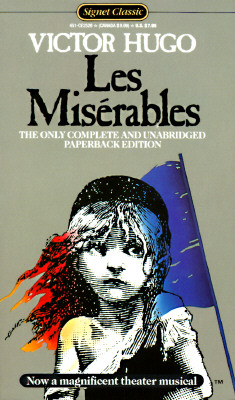
You’re Les Miserables!
by Victor Hugo
One of the best known people in your community, you have become something of a phenomenon. People have sung about you, danced in your honor, created all manner of art in your name. And yet your story is one of failure and despair, with a few brief exceptions. A hopeless romantic, you’ll never stop hoping that more good will come from your failings than is ever possible. Beware detectives and prison guards bearing vendettas.
Take the Book Quiz at the Blue Pyramid.

Thanks to Lisa at Eudaemonia, who by the way, has a posting on her recent Creative Writing seminar/workshop experiences that made me laugh even harder:  While she found it enlightening to free-write, that is, being given anywhere from five to fifteen minutes to immediately write down a particularly directed scenario for a particular element of writing, and did a wonderful job of it, it brought me back to a CW class where without thinking I asked the professor to please be quiet.

Posted in LITERATURE, REALITY | 2 Comments

WRITING: Huh, who me?

Little by little I’m chipping away at Todo Mountain, though it’s more like a response to the shrieks and screams and threats and disappointment–honest or faked–of those I may have let down in framing (customers) or housework (husband). 

Reading is still taking its portion of my limited energy and attention, which is great.  But writing and learning and playing with software to make audiovisual work has alas, been sorely neglected to the point where it’s practically alien to me.  I’ve tried several times to jumpstart myself with an idea and that fades before I have the word processing program or the Alice software open on the laptop.  (Why don’t I cut out here and race over there now since the laptop is well, in my lap?  Uh, I have to get these two pieces framed or to think about dinner or what’s happening Monday or…)

The beginning of the end of the general no-reading season is coming and that thought has started out as a whimper that may gradually wind up to a scream before May of ’08 when the end of the open submission period usually starts.

Somehow, some time before that all comes down, I’ll need to kickstart my creative mind back into gear.  Lord knows how, but I’ve a feeling that the longer I let it go, the less likely I’ll be to ever write again.  That happened with archery, and I was heavily into not only shooting, but making arrows and leather goods, had a national organization and a magazine.  I haven’t shot a bow in a couple of years now.

I’m waiting for that opening line that doesn’t come.  Inspiration isn’t there, initiative is inadequate, and real purpose does not exist. So I wait.   

Posted in WRITING | Comments Off on WRITING: Huh, who me?

LITERATURE: The Master and Margarita – Cheat Sheet

I’ve struggled through many a book refusing to seek out reviews and opinions of others.  Looking at this as both influence and plagiarizing of ideas, I feel that it’s always best to go it first alone and then look at what others have found that I have missed, or differ in interpretation. 

This novel is just loaded with symbolism, however; nothing, it seems, is straight out narrative relating the story(ies) which appears as the the first read(s).  That is, the reader can accept the meeting of two writers with the devil in Moscow, and the meeting of Yeshua and Pontius Pilate, or can follow the subtleties to discover more.  There is a commentary, chapter by chapter at the end of this version of the translated novel.  Since I’d already read four chapters, I did allow myself to read the notes on those chapters.  Very helpful and yet not too offputting about letting the reader discover things for himself.  Especially since there are so many references it seems to both other works (Faust, The Bible) and historical and cultural facts (the state of Russia) that I would have to be more aware of these things to get the full understanding of Bulgakov’s meaning.

So yes, I shall bite the bullet and "cheat" through this one a bit. 

Posted in LITERATURE | Tagged | Comments Off on LITERATURE: The Master and Margarita – Cheat Sheet

LITERATURE: Confessions – Again, the more things change…

Laughed aloud at this one:

My studies which were deemed respectable had the objective of leading me to distinction as an advocate in the lawcourts, where one’s reputation is high in proportion to one’s success in deceiving people.  The blindness of humanity is so great that people are actually proud of their blindness.  (III.6)

While I can certainly relate to the first sentence, it is not an uncommon belief, and in fact has become a joke about the legal profession.  But even I know that this is a generalization as well as an effect of the practice.

Augustine is guilty here of stereotyping; no worse, it would seem to me, than any other based on age, religion, ethnicity or gender.  Yet as I’ve always believed, there is a seed of truth within the exaggeration–and it should not be necessarily considered a bad thing if there is a logical reason of history behind it–in every statement that becomes a generalization.  I would think that the most important thing to remember is that maybe a majority, but certainly not all members of the group may have some trace of the tendency, trait, belief, etc. that the stereotyping targets.  Then too, as we merge and diversify our cultures, these may no longer hold true in any realistic acknowledgment.

The second sentence of Augustine’s statement, "The blindness of humanity is so great that people are actually proud of their blindness." reminds me, in these current times and affected by contemporary language and viewpoints, of political correctness, though I’m sure that this is not what Augustine is referring to, but rather a more mob mentality, ostrich-like behavior that excuses the reluctance to search for truth. 

Was there more honesty in Augustine’s time?  Likely so, and just as much deceit.

Posted in LITERATURE | Tagged | Comments Off on LITERATURE: Confessions – Again, the more things change…

TECHNOLOGY: Burn-In Repair

Amazingly, the burned-in line of the former desktop image has completely disappeared!

Once I realized that a thin white jagged line across the bottom of the screen was not a scratch as it seemed to get longer and spread out, I realized that it followed the lines of the image I used as a desktop.  First thing to do obviously is to change that desktop image, suspecting burn-in.  I kept the background dark so I could keep track of the line (okay, so I used purple, so what!) and for a few days it seemed again to blur and spread, but get lighter (or darker and less visible against the dark background).  This morning, it’s completely gone.

So I suppose that burn-in, if caught in time, can reverse itself. 

Posted in TECHNOLOGY | Comments Off on TECHNOLOGY: Burn-In Repair

LITERATURE: The Master and Margarita – Chapter 2

Chapter 1 leads into Chapter 2 as the strange foreigner, a Professor who claims to be in Moscow to decipher text of black magic, starts the tale of Jesus and Pontius Pilate, which is where the Chapter begins.

Names changed but clearly recognizable, the tale tells of the bringing in of the prisoner,Yeshua (Jesus), before Pilate for the final decree of life or death for the crime of inciting riots and denouncing Caesar subject to God as King.  Pretty much follows the basics as I recall my religious instruction and bible, the reluctant Pilate recognizing Yeshua as possibly a healer and philosopher, and more innocent than the other prisoners brought scheduled to be executed that day.  But one must be freed, and Pilate does his best to convince the religious leader to free Yeshua as he himself cannot do so without being seen guilty of treasonous behavior.

I’m not sure how one story relates to the other yet, and though it seems obvious that Berlioz the editor and Ivan the poet are atheist in belief, amid the setting of Russia they are secure.  It is the stranger who appears to surprised by their openness, yet though he is of questionable substance–having "appeared" from out of nowhere–he does not strike me as a particularly good character and therefore I peeked at the back cover to find–he is the devil!

Posted in LITERATURE | Tagged | Comments Off on LITERATURE: The Master and Margarita – Chapter 2

REALITY?: Set Free

Relief to hear the law’s no longer looking for me; an appeal was withdrawn and so I can unlock my doors and hover in the heated daylight hour.

Tonight I must go a-picking.  Cucumbers each large enough to fill a pickle jar itself for want of tending.  What will I do with all those cucumbers–and beans, the beans of course are all aripe at once.  I cannot even lay them out upon a table in the front yard with a sign that says they’re for the taking; One bad corner starts the yard and too many cars have flown instead of driven.

Tomatoes, of course, and peppers won’t be ready till September.  Stubbornly they grow and grow, refusing to turn red.  I’m craving BLTs and gazpacho and salsa, surely summer fare.

Posted in REALITY | Comments Off on REALITY?: Set Free

REALITY?: Outlaws

Willie and me, hiding from the Sheriff.  Honest to God.

It’s not as bad as it sounds, I mean, I’m not the bad guy.  I’ve just been warned that I’m Wanted as a witness in something I really don’t want or need to get involved in.  So I figure that if they can’t find me to serve a subpoena, then maybe they’ll give up and leave me alone.

And I can start a new life, me and Willie that is, in Mexico.

Posted in REALITY | 1 Comment

LITERATURE: A Work and Its Critique

I’ve forgotten and haven’t found through backtracking where I got this link to the Museum of Bad Art, located in a basement of a theater in Dedham, Massachusetts, but with the similaries and the differences in the fields of art and literature, as well as the marketing and market, I found the spoof of the art review as hilarious as the images chosen.

080207l

Acrylic on canvas by Unknown
Acquired by Scott Wilson from trash

This disturbing work “makes an offer you can’t refuse”. The chilling, matter-of-fact manner in which the subject presents the severed head to us is a poignant reminder of just how numb we have become. The understated violence implicit in the scene speaks volumes on our own desensitization, our society’s reflexive use of force, and the artist’s inability to deal with the hindquarters of the animal.

Posted in LITERATURE | Comments Off on LITERATURE: A Work and Its Critique

REALITY?: Civil Disrespect

With my experience of the last three years and the resulting newly established wariness of the justice system, I’d wandered onto a website that brings to light many of the worst case scenarios and frivolities that abound.  Overlawyered  has this item on suing the city for damages when a porch collapses on a multi-family house that causes the death of 13 people and injuring 50 more. 

Why sue the city?  Because it has more money than the 17 million availble from the homeowner’s insurance.  The worst part?  I mean beyond the greed?  The fact that one judge fell for it. 

That’s both the blessing and the curse of any judicial system.  Though you’d think it’d be cut and dry, there’s always the fact that it still comes down to interpretation, and my favorite, perception.

Posted in REALITY | Comments Off on REALITY?: Civil Disrespect

LITERATURE: Confessions – The More Things Change…

…the more they stay the same.  Barbara commented on the fact that some of what Augustine is writing about in his recollections of youth, such as peer pressure, exist as problems today. 

Here, in the beginning of Book III, I find more:

Why is it that a person should wish to experience suffering by watching grievous and tragic events which he himself would not wish to endure?  Nevertheless he wants to suffer the pain given by being a spectator of these sufferings, and the pain itself is his pleasure. (III:2)

CSI, Law  & Order, Adventure Games, Sporting events, Real life drama; they’re what get the ratings.  So man is still taken with the fascination of blood and guts, death.  I admit that I spent a good hour this morning checking out links on the suicide bridge–the Golden Gate–when I came across it on Michelle Redmond’s San Serif weblog.  There’s controversy, ongoing for decades it seems, on whether a suicide barrier is warranted.  1250 people have jumped and died to date.

As Augustine continues:

What is this but amazing folly? For the more anyone is moved by these scenes, the less free he is from similar passion.  Only, when he himself suffers, it is called misery; when he feels compassion for others, it is called mercy.  But what quality of mercy is it in fictitious and theatrical inventions?  A member of the audience is not excited to offer help, but invited only to grieve.  (III:2)

Interesting that while Augustine applies this line of thought to theatrical productions, therefore fiction, our contemporary tragedies are not only the fiction of theater, but the realties presented by the news media.  We know the difference between the two, and yet how different are our responses, how pure our intentions when we are not necessarily as helpless as in the case of theater?

And still, we watch.

Posted in LITERATURE | Tagged | 2 Comments

TECHNOLOGY: Burn-out/Burn-in

Even as I still hem and haw about the main pc repairs (meaning, which level of upgrade and repair is most cost effecient), the laptop was making me nervous with some little squiggle lines on the screen. It looked like I damaged or scratched the screen while wiping it, though I use only a soft cloth.  Then it dawned on me; the lines followed the painting of the owl I used as a desktop.  Even though I use a screensaver, and most often am either in a program or online, it seems that the laptop being almost four years old (though the image has only been on there maybe two) and being "on" almost constantly, daily, except for the six hours I’m asleep, the desktop was showing often enough to burn in the image.

I’ve also noticed darkness around the edges, so I’m hoping that the screen holds up for another year at least.  One thing for sure, I won’t be spending this much on a laptop again since as my main squeeze it’s getting heavy duty use.  I also, I suppose, should update the main pc to a super duper machine and with spare parts, upgrade the shop pc so that they’re used more often and share the burden that the laptop now carries alone.

Posted in TECHNOLOGY | Comments Off on TECHNOLOGY: Burn-out/Burn-in

LITERATURE:The Master and Margarita – Typical Russian Novel Opening

Yep, it brought me back many years to The Brothers Karamazov where everyone has at least a triple-name — Mikhail Alexandrovich Berlioz, and Ivan Nikolayevich Ponyryov (who writes under the pen name Bezdomny) are the two characters we meet by the second paragraph of this novel by Mikhail Bulgakov (who, poor man, is missing a middle name!).  By page three I was flipping back because I couldn’t believe that the same man was referred to by different names in the same sentence.

But there is so much delight here that overcomes my annoyances.  A discussion between the two above named characters who are editor and poet about the non-existence of Jesus Christ.  An odd foreign stranger who come up to them and politely asks to join the conversation.  As Bulgakov gives the the reader access to the consternation of the first two gentlemen towards the stranger, wondering where indeed he is from, he also gives us a clue as to the nature of the man.  A German? An Englishman? A Pole?  From France?  Set in Russia, these two would more easily narrow an European down closer than this.  And he speaks of breakfasting with Immanuel Kant, centuries dead.

Religion, philosophy, history, all here within the first short chapter and I’m going to love this: magical realism to bring it all together. 

Posted in LITERATURE | Tagged | 2 Comments