LITERATURE: Terms

Just found (and added a link to) a "guide to classical and ranaissance rhetoric":  The Forest of Rhetoric, a site run by Brigham Young University. 

It sure helped in reading On The Sublime in seeking out definitions of hyberbaton (sic) and polyptota and such.

Posted in LITERATURE | Comments Off on LITERATURE: Terms

LITERATURE: On The Sublime – Doing What Comes Naturally

Although I don’t quite understand the concept of "figures" as an element of the sublime, I’ve decided to plow ahead and grasp the meaning through the examples given.  This appears to relate to the manner in which passion is expressed:

Just as those who are really moved by anger, or fear, or indignation, or jealousy, or any other emotion (…) at times turn aside, and when they have taken on thing as their subject often leap at times to another, foisting in the midst some irrelevant matter, and then again wheel round to their original theme, and driven by their vehemence, as by a veering wind, now this way now that with rapid changes, transform their expressions, their thoughts, the order suggested by a natural sequence, into numberless variations of every kind; so also among the best writers it is by means of hyberbaton that imitation approaches the effects of nature.  For art is perfect when it seems to be nature, and nature hits the mark when she contains art hidden within her.  (Chapter XXII, Part 1)

Longinus then goes on to analyze the placement of phrases within a speech by Dionysius:

‘Our fortunes lie on a razor’s edge, men of Ionia; for freedom or for bondage, and that the bondage of runaway slaves.  Now, therefore, if you choose to submit to hardships, you will have toil for the moment, but you will be able to overcome our foes.’

Suggesting that proper order would seem to be:

‘Men of Ionia, now is the time for you to meet hardships; for our fortunes lie on a razor’s edge.’

Longinus is pointing out that the immediate danger "our fortunes lie on a razor’s edge" being placed at the forefront of the speech makes it all the more urgent and "of the moment" as is giving the reason for the action before the mention of what needs to be done.

There are two things that I’ve learned from this section:  That placement does impact statement and reception to that statement by calling up interest and excitement of the reader/hearer.  Secondly, I love the opening reference to passion following the ways of nature.  Aside from my tendency to start in the middle and pull in from without whatever is vaguely related as it hits me, to the constant amusement of my spouse, it was once pointed out to me that nature seems to appear in some form in all of my writings.  A recent story of mine actually has vegies metaphorically representing human nature.  I realize in reading Cormac McCarthy that part of his draw for me is his intensity with the earth that dwarfs the people who walk it. 

And then too, I get a lot of my answers to the questions in life straight from the early morning sky.

Posted in LITERATURE | Tagged | Comments Off on LITERATURE: On The Sublime – Doing What Comes Naturally

REALITY?: Annoyances

Not in the best of moods.  My jelly won’t jell and the sock on my left food keeps twisting around into a lump.

Posted in REALITY | Comments Off on REALITY?: Annoyances

Current Affairs: Gubernatorial Debate

Watching the debate for governor, and while I really feel that Connecticut needs some new blood, DeStefano ain’t the key.  No matter what question is asked, he gives it as little thought as possible in order to reiterate two points, a road project gone wrong and a rail system that won’t make it to Grand Central Station.  Rell handled herself well and with grace, which could easily be just spit and polish, but at least she wasn’t on the attack.

On one question, DeStefano sounded oddly conservative.  The question raised by a constituent was "What are you going to do about affordable housing for the homeless?"  While the question doesn’t make a whole lot of sense, since the homeless could never afford housing of any sort, he answered by bringing in education (delayed resolution) so that people can earn decent incomes and afford housing.  Unfortunately, DeStefano also wants to hit the wealthy and the corporations with heavy taxation, which means they likely will be leaving the state and taking the jobs with them.

On the plus side, he may have gone through the whole debate without using the words "war" or "Bush" which seems to be the slogan campaign of the Democrats this year.  In his closing statement, DeStefano continues getting his jabs in about how bad the other guy (Governor Jodi Rell) is and doesn’t hold goodness and decency as being exceptionally important in a governor either.  Some of his plans are so shortsighted that I don’t blame him for spending his words on attack rather than on presentation.  His windfall tax cure, for example, seems oblivious to the fact that it would immediately be rectified by higher prices to the consumer.

Not impressive.

Posted in CURRENT AFFAIRS | Comments Off on Current Affairs: Gubernatorial Debate

STORIES: Winds

A scattered few puffs of lone clouds met over the Rockies, blown by the northwest wind into a gathering of a gray ragtag army marching over the plains, stopping to drink at the Great Lakes of Michigan’s banks, holding its breath as it filled in its ranks in a faster-paced mass over the widest part of New York, meeting its enemy and unloading its full charge of bullets of rain into the City, soaking the streets and the alley where the man known as Zeller lay dead.

Posted in STORIES | Comments Off on STORIES: Winds

LITERATURE: A Clockwork Orange – Language First

Aside from the easy violence of this future world, there is the language of the first person narrator (Alex) to accept.

Then brothers, it came.  Oh, bliss, bliss and heaven.  I lay all nagoy to the ceiling, my gulliver on my rookers on the pillow, glazzies closed, rot open in bliss, slooshying the sluice of lovely sounds.  (p. 38)

From context, we can figure out that he’s laying on his bed with his hands under his head on the pillow with his eyes closed, mouth open, listening to the flow of the music.

Every now and then we get a lesson:

(…) so that I had one in the shape of a spider, Pete had a rooker (a hand, that is), Georgie had a fancy one of a flower, and poor old Dim had a very hound-and-horny one of a clown’s litso (face, that is), Dim not ever having much of an idea of things and being, beyond all shadow of a doubting thomas, the dimmest of we four. (p. 4)

I’m not sure whether it’s because we haven’t come to these words earlier or whether Burgess took this opportunity to clarify by giving us the definitions, but it bothered me a bit to have it explained in parentheses.  It could be cleverness on Burgess’ part, but then again, hand and face will come up often, and they’d be words that are fairly easy to figure out.  But there are a lot of questions that this created language brings up.

In most futuristic novels, there is going to be words made up to fit the time period, particularly in fantasy worlds which are so popular these days.  But in a first person pov, it’s rare to speak so differently except to name certain objects or places that wouldn’t exist in our contemporary world.  So the slang of the narrator, directly spoken to the reader, is rather unusual.  Or, is this what indeed should be considered by fantasy and sci fi writers; that their characters would be speaking so very differently than we do now? 

In getting accustomed to the language, do we read in full understanding of the sentence or do we mentally switch rooker to hand without thinking about it?  Remember the experiment of writing a sentence without using all the letters of the words and having people read it easily, as if nothing were missing at all?

In reading a novel that uses phrases or words from another language, such as Nabokov’s Lolita in which Humbert Humbert often reverts to French, we may or may not choose to bother looking up the translation.  In A Clockwork Orange, we don’t have a choice.  We simply can’t.

I’m wondering too whether the story is changed in any way by the difference in language.  Would the bloodied mouths and ripped guts have the same impact?  Is the violence hidden or softened at all within the language? 

And yet, the narrator while keeping his distance in this space foreign to us, keeps calling to us, "O my brothers," that makes us a part of it all.
Posted in LITERATURE | Tagged | Comments Off on LITERATURE: A Clockwork Orange – Language First

WRITING: Publishing and Such

I definitely need to update my link lists, recategorize them, and add so many that I’ve found and added to my Bloglines read list but may have neglected to place them here.  Usually a complete overhaul happens during January, when I decide to repaint and redecorate the site.  But there’s a couple I ran into recently that I must point out to writers.

Books and Coffee is a weblog kept by Victoria, a bookseller whose snappy writing makes it a fun as well as informative visit.  Check out today’s post which really gives the writer a view from the bookstore end.

And this one I found today, Lit Soup, from Jennifer we get the literary agent’s angle.

Posted in WRITING | Comments Off on WRITING: Publishing and Such

REALITY?: Did you know…

…that you can’t quit coffee cold turkey?  The doctor tells me that you can have withdrawal.  So I’m vacillating between changing what I drink in the shop vs. at home, and going decaf first and gradually into Postum, Piro, or some sort of caffeine-free tea.

Well, we’ll see what that accomplishes in the next two weeks.

Posted in REALITY | 3 Comments

LITERATURE: Building

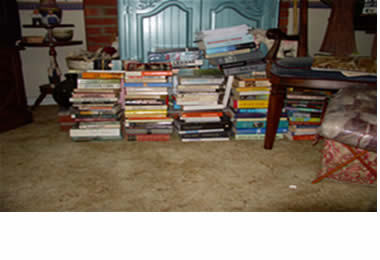
101706l Okay, so here’s how the “To Read” pile looks after a couple of Library Book sales, and unfortunately, just a week or two prior to another.  Frankly, I have to proudly say that of all the library sales I’ve been to lately, my own home town library has had the best selection of classics and classic novels.  Whether this means they’re wonderfully not into Danielle Steel, or they’ve decided to dump the good stuff in favor of her, I can’t say.  But I’ve consistently been able to find a good ten or more books off my list to pick up there.

Now, to show the “Books I’ve Read” pile.  This is from just under a year, and they’re sitting there waiting for book shelves to be built.

101706l2

Posted in LITERATURE | Tagged | Comments Off on LITERATURE: Building

LITERATURE: A Clockwork Orange – Not Sublimity of Language and Concept?

Or perhaps it simply cannot be judged by Longinus or time:

The old veck began to make sort of chumbling shooms–"wuf waf wof" — so Georgie let go of holding his goobers apart and just let him have one in the toothless rot with his ringy fist, and that made the old veck start moaning a lot then, then out comes the blood, my brothers, real beautiful.  (p. 10)

Futuristic, violent.  Not war violence nor necessary in any form; just fun stuff.  But there may be redemption in presentation here.  The language is certainly new, a slang of the times, purely made up by the author, Anthony Burgess.  Easy enough to figure out when put into context, and as a matter of fact, I worry that literature’s influence on me may have taken me straight out of the formality of Poe into the nether world of Burgess, so a trip back to my favorites, McCarthy, Marquez, Faulkner and Steinbeck may be the eventual cure.

But doesn’t change sometimes represent elevation?  In conceptualizing a different world, can we not discover the sublime in either ideal or repulsion?  Repulsive is not what Longinus allows, but surely there’s place for it when as Aristotle claims, there cannot be the good without the bad, attraction and repulsion being the necessary opposites.

As for concept, in the middle of this scenario with the narrator and three malchicks (dudes) scouting out ptitsas (girls?) to…well, whatever; I don’t believe we’ve come to the eral word for fuck yet, and the vecks (old dudes) to roll, I find this thought, based on taking some sort of drugs:

You came back to here and now whimpering sort of, with your rot all squaring up for a boohoohoo.  Now, that’s very nice but very cowardly.  You were not put on this earth just to get in touch with God.  That sort of thing could sap all the strength and the goodness out of a chelloveck.  (p. 6)

There’s going to be a helluva lot to discover in Burgess’s world, and I wonder if Longinus can still be my guide.

Posted in LITERATURE | Tagged | Comments Off on LITERATURE: A Clockwork Orange – Not Sublimity of Language and Concept?

LITERATURE: Next Up–A Clockwork Orange

This novel by Anthony Burgess should be a big change from the South of Faulkner, Morrison and McCarthy.  I’d seen the film back when it came out in 1963 or so, but don’t remember much of it.

Should be quite an adventure.

Posted in LITERATURE | Tagged | Comments Off on LITERATURE: Next Up–A Clockwork Orange

LITERATURE: On The Sublime – Imagery

From Longinus (or whoever):

Images, moreover, contribute greatly, my young friend, to dignity, elevation, and power as a pleader.  In this sense some call them mental representations.  In a general way the name of image or imagination is applied to every idea of the mind, in whatever form it presents itself, which gives birth to speech.  (…)Further, you will be aware of the fact that an image has one purpose with the orators and another with the poets, and that the design of the poetical image is enthralment, of the rhetorical–vivid description.  Both, however, seek to stir the passions and the emotions.  (Chapter XV, Part 2)

With Cormac McCarthy it has always been a dual purpose.  The description is always vivid, especially so with his story world environment.  But it is truly stirring as well:

The snow had stopped.  Scout was standing in snow to his belly, gazing out at the fantastic landscape with his bleary eyes.  Across the yard, brilliant against the facade of pines beyond, a cardinal shot like a drop of blood.  (The Orchard Keeper, p. 133)

Once we’ve been led through McCarthy’s landscape and have come to see the expanse of it from the top of the mountain through Uncle Ather’s eyes, we place within it the flaws, the body rotting in the pit of green scum, the brown muddy water of the hurrying creek, and the comings and goings of Rattner and Sylder making their way through this world.  A cardinal becomes more than a bird; it is a blood-red reminder of life and death.

Posted in LITERATURE | Tagged | Comments Off on LITERATURE: On The Sublime – Imagery

WRITING: EDITING!!!!!

Knew I should’ve depended upon another pair of eyes–at least for the copy editing, though story likely could have used it too.

After sending a story out to two journals, I read it and in the third paragraph find a double "the."

How embarrassing.

Posted in WRITING | Comments Off on WRITING: EDITING!!!!!

LITERATURE: On the Sublime – Imitation

I particularly like this bit of wisdom:

Accordingly, it is well that we ourselves also, when elaborating anything which requires lofty expression and elevated concepetion, should shape some idea in our minds as to how perchance Homer would have said this very thing, or how it would have been raised to the sublime by Plato or Demosthenes or by the historian Thucydides.  For those personages, presenting themselves to us and inflaming our ardour and as it were illumining our path, will carry our minds in a mysterious way to the high standards of sublimity which are imaged within us.  (Chapter XIV, Part 1)

Longinus is saying that we can learn from the masters. While it is not necessary to stop and think how  Homer might say it, the absorption gained from reading Homer, et al, will find its way to influence our patterns of speech and writing.  You can see Faulkner’s influence on McCarthy, and McCarthy then takes it a step further in other directions.  Anyone who has read and loved McCarthy cannot help but develop a feel for stark imagery in description.

In other words, read, read, read.

Posted in LITERATURE | Tagged | 1 Comment

LITERATURE: On The Sublime – Age Discrimination

In citing examples of sublimity in Homer’s Odyssey and the Illiad, Longinus points out the action and therefore, passion of the Illiad, written "at the height of his inspiration," versus the narrative of the Odyssey, "as is characteristic of old age."  He further likens Homer "to a sinking sun, whose grandeur remains without its intensity."

This surprises me, for while passion of youth is spirited, it is often just as strongly misguided as it is intense.  Maturity’s passion, it would seem to me, is held within careful worded wisdom, the passion nonetheless diminished by its finesse. Though of course, "there’s no fool like an old fool" wasn’t coined without reason.

In the end of this chapter (IX), there is this:

These observations with regard to the Odyssey should be made for another reason–in order that you may know that the genius of great poets and prose-writers, as their passion declines, finds its final expression in the delineation of character.  For such are the details Homer gives, with an eye to characterisation, of life in the home of Odysseus; they form as it were a comedy of manners. (Chapter IX, Part 15)

While Carson McCullers struck immediately the goldmine in her brain with her very first novel, The Heart is a Lonely Hunter, after reading Cormac McCarthy’s first, The Orchard Keeper, and the difference between this and his later novels, it would appear to be in direct opposite with what Longinus claims here.

While McCarthy’s characters may be better drawn in his early novel, the characters of the later ones are so multilayered that it is left to the reader to decipher them.  His imagery in description of environment–his being so taken with the land in particular–of The Orchard Keeper is where his passion truly comes through, and that is all narrative.  The action, as we see, is minimal; barely enough to keep a story plot going.

Maybe it’s me as a writer who has gotten her hackles up at the insinuations of mellowing age here.  But I really feel that I write with more passion now than ever before, and with more intelligent and reflective passion at that.  Especially in writing, time allows for a controlled form of passion.  One can write while in the throes of inflamed inspiration–especially with weblogs these days.  Yes, I would admit that my more dangerous and uninformed passion will occasionally flare more quickly and amplified in oratory, but that’s another story.

Posted in LITERATURE | Tagged | Comments Off on LITERATURE: On The Sublime – Age Discrimination