LITERATURE: Reading and Influence

I've always pushed my belief that reading of all sorts (as long as it's a diverse list) grants a certain reinforcement of knowledge and likely shapes one's language abilities as well as one's values and perspectives.

After just having read Milan Kundera's The Unbearable Lightness of Being, I'm surprised to come upon the title phrase twice within the last couple of days. Once, in Yann Martel's Life of Pi:

Considering that animals dispense with clothes, footwear, linen, furniture, kitchenware, toiletries; that nationality means nothing to them; that they care not a jot for passports, money, employment prospects, schools, cost of housing, healthcare facilities–considering, in short, their lightness of being, it's amazing how hard it is to move them. Moving a zoo is like moving a city. (p. 112)

And somewhere in my surfing today as a reference to Sarah Palin (I honestly can't find the link or remember which article made the statement).

What would the words "unbearable lightness of being" mean to me had I not read Kundera? It surely has clarified the statements by having read the book. Would I have just "read over" the words? Would I have assigned a meaning not quite as acute?

Posted in LITERATURE | 1 Comment

LITERATURE: Life of Pi – And the Dimwitted Reader

Just realizing now that the italicized chapters are those of author intrusion; Martel perhaps, as narrator, rightly in the future, looking back at his first meetings with the character, Pi.

Maybe close reading is not close enough, or too close to see.

Martel's use of this in what I am now considering to be a work of fiction, despite the opening Author's Notes, is likely to keep the reader in close proximity to the story–by keeping him close to the storyteller. This is effective (I'm sure, though I'd missed the whole point up till now) in perhaps building the dramatic effect of the story by ensuring that there is a future for the character, and tying together the boy of the story to the man of the author's chapters.

Posted in LITERATURE | Tagged | Comments Off on LITERATURE: Life of Pi – And the Dimwitted Reader

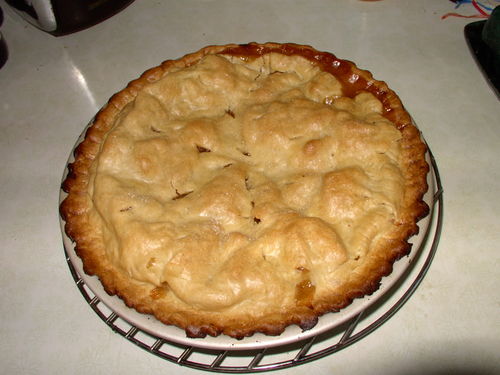
REALITY?: Oven-Broke Apple Pie

102608r

Not my best, and a bit burnt on the edges, but when you end up using the Weber  gas grill to bake a pie, at least you know that you can.

It’s a question of should the old gas stove be replaced or should I bother with calling in a repairman? It’s an old, cheap oven that came with the house, likely 35 years old, and the plan is to eventually renovate the kitchen so I wanted to wait until I know where and what size stove I’d get. Hate it when I’m forced into making an emergency decision or purchase. But with the current state of the economy, I’m hesitant to spend a penny more than I have to for anything.

Then again, I can’t see me roasting Christmas dinner outside in the snow…

Posted in REALITY | 1 Comment

LITERATURE: The Life of Pi – Writerly Text

Barthes' theory of writerly versus readerly text is a constant with me now, and I find proof of it again and again as I relate my own perspective to a writing, often coming up with something not likely the main intent of the author.  Then again, this particular section from Martel's Life of Pi clearly relates to Pi's thoughts about religion, and I have taken it out of context to describe human nature:

These people walk by a widow deformed by leprosy begging for a few paise, walk by children dressed in rags living in the street, and they think, "business as usual." But if they perceive a slight against God, it is a different story. Their faces go red, their chests heave mightily, and they sputter angry words. The degree of their indignation is astonishing. Their resolve is frightening.

These people fail to realize that it is on the inside that God must be defended, not on the outside. They should direct their anger at themselves. For evil in the open is but evil from within that has been let out. (p. 89)

And to highlight this next line:

The main battlefield for good is not the open ground of the public arena but the small clearing of each heart.

This has been my feeling all along. If we bother to see the trees instead of trying to fence the forest. If we each realistically helped one other person, more if we're able, doing what we can physically with a meal, money, shelter, clothing when we come upon someone less fortunate, or someone in need of a willing ear or emotional support,it will do a lot more good than endless ranting and rallying for others to do it for us.

Posted in REALITY | Comments Off on LITERATURE: The Life of Pi – Writerly Text

LITERATURE: Life of Pi – Sorting It Out

Not that I would take a novelist's opinion on religion any more as fact than I do some movie star's slant on politics, when there is a seed of thought to ponder, a different perspective, it's always an added bonus to a story:

I can well imagine an atheist's last words: "White, white! L-L-Love! My God!"–and the deathbed leap of faith. Whereas the agnostic, if he stays true to his reasonable self, if he stays beholden to dry, yeastless factuality, might try to explain the warm light bathing him by saying, "Possibly a f-f-failing oxygenation of the b-b-brain," and, to the very end, lack imagination and miss the better story. (p. 80)

Pi has just embraced the Muslim religion–in addition to the pull of Christianity and his own beloved Hindu. His curiosity has led him into further study and practice and he seems to find something of value in each. What he has also thought about is the importance of the moral sense, which he feels is more important to seek and follow than an intellectual understanding of things, and this is what brought him to the statement quoted above.

Martel interjects a different timeline, one that is future to the story of Pi's childhood and teenage years. In there he has considered the words of a friend who gave him the phrase "dry, yeastless, factuality,"

It's a wonderful phrase and yet I wonder if it depicts accurately a philosophy; I would think that facts, though perhaps lacking imagination once they've been established, instead are truly based and dependent upon man's imagination to discover them. "Yeastless" would indicate inability to grow, and yet many of the "dryest" facts are mere building blocks of creativity that continues outward. Otherwise, the wheel would not have bred the car.

Posted in LITERATURE | Tagged | Comments Off on LITERATURE: Life of Pi – Sorting It Out

REALITY?: Catholic Penance or Just Simply a Haircut?

102408rOkay, you get one shot of me here because I’m rather proud of having given myself a fairly decent haircut, almost like my mother used to do but without the high layered back beyond a feeble inch or so. I’ve always cut my own hair (or got my mother to do it) but to get the back layered was near impossible for the old “Sassoon” style that’s always been my favorite.  One time I cut the top and sides real short and chickened out and ended up with the back real long. I’ve never tried the Sassoon again until now. And ‘now’ not only coincides with my shorter ‘do’ for winter (in summer it needs to be long enough to put up) but with the loss of my mother’s wedding ring which I’ve worn for four years now.

Huh?

Well yes, there’s that Catholic guilt that you never really lose and if you’ve been through the parochial school system as well, the hairshirts and the flagellation and the cutting off of one’s crowning glory of hair don’t die easy. I even considered taking the inches cut off and tossing them out to the winds in the hope they’d help me find the ring somewhere in the lawn but thought that was going a bit too far. I crawled around on my hands and knees instead.  Wait a minute, didn’t Saint What’s His Name do that as penance for something? Like not eating his peas or not taking off his hat in church?

Posted in REALITY | 2 Comments

NEW MEDIA: The Newest Kindle

Even with Amazon's offer of Oprah's $50 off certificate, the newest Kindle still runs $309 which is all well and good, but the books are where I get off the new technology train.

New releases and best sellers are $9.99 each. Yes, you can store but you can't share a book unless you lend out your Kindle too. On the seller's side, he's selling the same book over and over again without much cost to him. You also can't put the book on your shelf. It just remains asleep inside your Kindle until you run out of room and replace it.

Now maybe it's because I don't usually read the bestsellers (at least for another twenty years–I'm a hard person to convince) so maybe I'd save money because the classics that I seek would be much cheaper–I don't know, I haven't looked. But then, aren't 'classics' meant to remain on bookshelves for re-reading?  Or maybe it's because I'm a physical type; I need to touch paper and smell the musty pages and see the color of the book cover to make me feel a part of the experience.

Maybe once Kindle's price per book goes down a bit, or maybe when it allows you to post to your weblog as you read–since that's my main interaction with books–I'll reconsider. Or maybe when I'm a world traveler and need six months' supply of reading as I trampsteam down the river to Timbuktu. But for now, I guess I'll have to stick with my old-lady laprobe, flipping pages, and forever falling-out bookmark.

Posted in NEW MEDIA | Comments Off on NEW MEDIA: The Newest Kindle

LITERATURE: Some Good Additions

Well, I got fourteen books for ten-fifty plus four bucks for 'early bird' rights. Here's the take:

Running with Scissors by Augusten Burroughs
The Canterbury Tales by Geoffrey Chaucer
The Idiot by Fyodor Dostoevsky
Tom Jones by Henry Fielding
Far from the Madding Crowd by Thomas Hardy
A Doll's House by Henrik Ibsen
Elmer Gantry by Sinclair Lewis
The Captive by Marcel Proust
A Summons to Memphis by Peter Taylor
The Adventures of Huckleberry Finn by Mark Twain
A Streetcar Named Desire by Tennessee Williams
Orlando by Virginia Woolf
A Room of One's Own by Virginia Woolf
        And, an exciting find in Living to Tell the Tale by Gabriel Garcia Marquez

Five of the books were on my "To Buy" list so that added to the delight of my library jaunt and the joy of books at such great prices. Then I went out to dinner and spent thirty dollars on one meal that'll be gone by tomorrow.

Posted in LITERATURE | 2 Comments

LITERATURE: Library Book Sale Today!

What is it with me: I believe New Hampshire is fifty miles away, that I can run errands with ten stops in under half an hour, and that I can read all the books I have on my shelves.

In preparation for the book sale this afternoon, I've copied and printed out the listings in the sidebar so that I don't keep coming home with duplicates. Then, as would anybody with a mathematical mind, I counted them up: 250 unread in the bookcases, 150 read already (not counting all Stephen King's, the Nancy Drew and Hardy Boys series, the years of mystery and crime and romance where I went through a book a week or more, and any of those I simply don't remember). Of course, my analytical nature forced me to carry this train of thought to its unhappy conclusion: In the past couple of years I've read on average only fifteen to twenty books a year. Which means I'm not likely to be alive long enough to go through all I already have to read.

Which means that I have to read faster, play with the computer a lot less (though I've heard that I should in fact play more, and games at that), or retire early if I don't want to leave behind a rock in the woods that says "Susan – She didn't finish her reading." under which my ashes lie perpetually in shame.

But then, there's a book sale today, and I just can't not go.  It used to be shoes.

Posted in LITERATURE | Comments Off on LITERATURE: Library Book Sale Today!

LITERATURE: Life of Pi – Which God Would You Vote For?

I love it; the comparisons Pi is coming up with to get his head around the Catholic God and in particular, the Son, Jesus:

This Son is a god who spent most of His time telling stories, talking. This Son is a god who walked, a pedestrian god–and in a hot place at that–with a stride like any human stride, the sandal reaching just above the rocks along the way; and when He splurged on transportation, it was a regular donkey. (p. 70)

The argument is wonderfully colloquial. It is a train of thought that displays a reasoning process–though that reason is bound by Pi's knowledge and belief of his own theology. One thing I become aware of here, however, is the capitalization of references to God, done much in the Christian manner that is taught in religious schools and is nearly impossible to shake as a habit of writing.

And this Son appears only once, long ago, far away? Among an obscure tribe in a backwater of West Asia on the confines of a long-vanished empire? Is done away with before He has a single grey hair on His head? Leaves not a single descendant, only scattered, partial testimony, His complete works doodles in dirt? Wait a minute. This is more than Brahman with a serious case of stage fright. This is Brahman selfish. This is Brahman ungenerous and unfair. This is Brahman practically unmanifast. If Brahman is to have only one son, He must be as abundant as Krishna with the milkmaids, no? What could justify such divine stinginess?

Love, repeated Father Martin.

I'll stick to my Krishna thank you very much. I find his divinity utterly compelling. You can keep your sweaty, chatty Son to yourself. (p. 70)

You gotta admit, this is great stuff. How do we decide our beliefs when faced with alternates? How do we pick our candidates, our leader of choice? Pi appears to decide on the basis of power, strength, something divine that is as far away from his understanding of human nature as possible. Yet the Catholic God has chosen to display Himself as not only human, but not one of wealth, power, or nobility.

I suspect that we also harbor these tendencies in our selection of national leaders; that they be at best, not like us. After all, we understand why we wouldn't want to see ourselves in such positions, then it makes sense not to trust someone who is not above our own capabilities (and failings) as our choice.

But then there's another aspect, in choosing both a God (or none) or a leader: What can He/he do for us?

Posted in LITERATURE | Tagged | Comments Off on LITERATURE: Life of Pi – Which God Would You Vote For?

STORIES: (No Title Yet)

Bradley Verasovich was one of those kids you just knew would turn out bad. No, he didn't bury kittens in sand up to their head or pull wings off flies; as a matter of fact, there was a short span of a couple months one summer where he caught flies, those large horse flies, and kept them in jars as pets. He'd painted little windows and a red door on the jar and fed them peas.

Posted in STORIES | Comments Off on STORIES: (No Title Yet)

LITERATURE: Life of Pi – Pi on Religion

Martel has foreshadowed religion as a topic that would be considered by Pi, by his comparing it to zoos, and in subtle ways that certainly led to his admission that religion is indeed important to him, and Hinduism formed his basis for all other thoughts about life.

Here, while the family is on holiday, Pi wanders purposefully into a Catholic church:

Despite attending a nominally Christian school, I had not yet been inside a church–and I wasn't about to dare the need now.  I knew very little about the religion. It had a reputation for few gods and great violence. (p. 64)

Catholics have a reputation for severity, for judgment that comes down heavily. (p. 66)

As a Catholic, I find this a hoot, though it seems to be a bit more commonly held an opinion than I guessed. Luckily, Pi finds that his fears are ungrounded as well, as he has tea with Father Martin who tells him a story:

And what a story.  The first thing that drew me in was disbelief. What? Humanity sins but it's God's Son who pays the price? I tried to imagine Father saying to me, "Piscine, a lion slipped into the llama pen today and killed two llamas. Yesterday another one killed a black buck. Last week two of them ate the camel. The week before it was painted storks and grey herons. And who's to say for sure who snacked on our golden agouti? The situation has become intolerable. Something must be done. I have decided that the only way the lions can atone for their sins is if I feed you to them."

"Yes, Father, that would be the right and logical thing to do. Give me a moment to wash up."

"Hallelujah, my son."

"Hallelujah, Father."

What a downright weird story. What peculiar psychology. (p. 67)

The kettle of religion is boiling again, with the above "myth" being actively debated online, and in fact, in waiting for the new dirty word that the Fall television debuts would bring (last year's was ass, I believe) I've noticed that by the second show of any drama series, there's someone proclaiming the nonsense of religious belief.

I do enjoy the manner in which Martel approaches some of these dramatic points in the novel; they are not just treated with light humor, but in a very down-to-earth, human way that I find delightful. Martel's message comes through however; he is careful not to overshadow his meaning with rhetoric.

Posted in LITERATURE | Tagged | Comments Off on LITERATURE: Life of Pi – Pi on Religion

NEW MEDIA: The Pros and Cons of Social Networking

(UPDATE: More on Social Networking, a series of postings at Hypercompendia/Social Networking)

We've embraced the wonders of the internet, the amazing opportunities it offers and the world it opens up to every individual with computer access. We've come a long way from piling into the wagon to drive fifty miles to Grandma's for a weekend visit. The postal service has improved since they've been able to use mailtrucks and airplanes instead of horses and steamships. The telephone added the sense of hearing though the visual suffered for it. And now the web along with weblogs and twitter and Facebook and a dozen different social networking services limits the dark corners to hide in.

But even the weblog is outdated, I've heard, and it's being suggested that we "pull the plug on blogs": 

The time it takes to craft sharp, witty blog prose is better spent expressing yourself on Flickr, Facebook, or Twitter.

If you quit now, you're in good company. Notorious chatterbox Jason Calacanis made millions from his Weblogs network. But he flat-out retired
his own blog in July. "Blogging is simply too big, too impersonal, and
lacks the intimacy that drew me to it," he wrote in his final post.

Now I've likely just hurt someone's feelings by being less than enthusiastic about joining diigo after sending an email with data to share. I've apologized, and I do understand the use of diigo (or I'm trying to) as a tool for sharing, but it seems that while I've breached a certain code of camaraderie in wanting to pass information to an individual rather than splatter it on a website, it does take away even that little smidgen of a personal touch that email manages to cling to.

I'll admit that I'm eternally grateful to the system, and likely one of the very same type of person I'm here to complain about. "I'm a writer, I'll send you an email," I say, often staving off the phone conversation that once was an important part of my life. Nowadays, there are only a few friends I talk to via telephone–and that's actual voice-talking, not text messaging. Once email and weblogs were invented, I figured I'd found my niche. I've also dabbled in Twitter, Facebook, Myspace, Plurk, and now diigo.

But there're some drawbacks to the social networking via the web. It's not something I've done a study on, but I've been getting the general feeling of a lack of politeness in both the real world and the semi-real world of the internet. For example, with job postings and responses done via websites, there are hundreds competing for the same job, so I do understand that response from a prospective employer would be more difficult, but these days, an applicant never knows if he's being considered or got dumped within minutes. Because it's so easy to avoid responding, this same thing is happening on weblogs, and in the social networking groups. Just for shits, I've written some outrageous things on twitter or on a blog (and some deeper, more personal sharings) and received absolutely no conversation. You know folks have read it, and yet there's no human reaction as a sign of empathy or surprise or whatever. While you've made some friends via these means, the friends that you might ordinarily expect to talk with in person (if they read your web communications at all), have that option of ignoring what they read.

How would this play out in person? Would they silently turn around and walk away? See, social networking on the internet isn't really very social when you look at it that way.  Here's another viewpoint, from Don Tennant at ComputerWorld, referring to another article by Kip Layton, a school administrator in a tiny town in Alaska regarding email and its effect on handwriing. Don gives us his feelings about snail mail when his son's computer is down:

People over 35 generally have lovely handwriting. The 25-to-35 age
group has decent handwriting. And the under-25 crowd is a legibility
laughingstock. It's all because of computers. And it's kind of a shame.

(…) I clearly could have written the letters on my computer and printed
them out, but I didn't. I suppose the reason is that I can remember as
a kid getting letters from my mom and dad and noticing their different
styles of handwriting and appreciating that unique personal expression.

I wanted my son to see that same expressiveness and individuality and
personality in my correspondence with him, so I've been writing my
letters to him longhand.

Hadn't thought of that; I treasure recipes, notes, cards, little papers where the writing is clearly that of my mother, or my father, or someone else dear to me. It's not as personal as physical presence, but it's sure a step above the cold type of an email.

Now maybe I'm just more bothered by this than most folk, as I'm more the type that have a precious few close friends and another layer of well, friends, and a lot of acquaintances so I'm not trying to expand either my presence or my popularity.  But I see more than just a separate society online. Frankly, I see the same avoidance of connection, the rudeness, the same distancing that expands a circle of friends to global yet moves those one would be in contact with via phone or in person to that same level, and that same ease of slipping away that the internet allows creeping into the realities of face to face living. It need not be that way, but there's a couple of generations now that have been brought up in this new world of great possibility and possible dehumanization of society.  And some of us, the ones who notice these things, won't be here to remember them.
Posted in NEW MEDIA | Comments Off on NEW MEDIA: The Pros and Cons of Social Networking

LITERATURE: Life of Pi – Drop Phrases

There are interesting little tidbits of thought that Martel drops through his story that seem to have some special importance, that relate to man’s questioning of life, yet are put in a stark, interesting way. Here, Pi has just listened to one of his favorite teachers explain his own loss of belief in God after a childhood bout with polio:

It wasn’t for fear of angering Mr. Kumar. I was more afraid that in a few words thrown out he might destroy something that I loved. What if his words had the effect of polio on me? What a terrible disease that must be if it could kill God in a man. (p. 35)

Martel has an interesting way of seeing things, of displaying them to the reader. Loss of faith is a major trauma; questioning faith is one for Pi. He still holds religion dear and he’s just seen how easily it can be lost.

His father, the zookeeper has another lesson to teach Pi and his older brother, Ravi; the danger of considering the animals in the zoo, from the smallest birds to the big cats, as not dangerous because of the adjustments they have made to their secure lives.

In both cases we look at an animal and see a mirror. The obsession with putting ourselves at the centre of everything is the bane not only of theologians but also of zoologists. (p. 39)

He brings in the idea of stuffed animal toys that try to change the truth into what man prefers to believe, sort of like the Bambi version of nature that is more acceptable to us, though far from reality. The danger, of course, is in replacing reality with our preferred version of fact, since the reality lurks beneath our mask of it.

Very interesting method so far, of Martel’s comparisons of the zoo with religion. He is evidently leading us on and into a more complex meaning of human nature.

Posted in LITERATURE | Tagged | Comments Off on LITERATURE: Life of Pi – Drop Phrases

LITERATURE: – Read for What?

For entertainment, enjoyment, and, for learning. From fiction? Sure, why not. I’ve as much faith in a good author’s presentation of life as I do in the media, perhaps more.

And facts? Well I may not get the details of a war, but I’ll get a feel for how it affected its society as a result. Facts are rarely completely unbiased in that they depend upon human beings to report them. Perception is a large part of our awareness, thus colors all that we experience. How else can we have half a country want one candidate and the other half, the other. How can the same statement, clear and in print, be interpreted in two such opposite ways.

My feeling is that novels of import are those that will teach something of which can be found in textbooks, whether it be history, sociology, philosophy, or psychology and at its best, a story can offer a little of each. I like to see several different viewpoints of the same human experience and see them in an entertaining way that makes it more interesting than flat information gleaned from a textbook. Can a case described in clinical terms in a psychology textbook leave as lasting an impression as a character drawn by Marquez or McCarthy? Can we understand mental deficiency by its textbook statement of signs and characteristics any better than we can via Faulkner’s Benjy? It depends upon what level of knowledge we are seeking and for what purpose.

For me, what I learn from good writers is more relevant to my own life than what I would find in a classroom statement.

Posted in LITERATURE | 2 Comments