CURRENT AFFAIRS: Guilt by Association

I do take the American citizen’s right to vote in our elections seriously and while I may have joked about strategy in having my current party affiliation, it gave me the opportunity to vote in the primaries and I felt that this was important.  I am willing to give up this right and have printed out the change of registration form and will head for town hall tomorrow morning.

Why?  Basically because even though it’s been my policy to split the ticket and vote for candidates rather than the party platform alone, and while I realize that being noted as a Democrat or a Republican (or Green, or Libertarian, or whatever) does in no way reflect complete agreement with party stance, I cannot in good conscience remain saddled with a label that defines me as possibly accepting the deceit and downright maliciousness of even a small sector of that party’s beliefs.

In a simpler life, of course I’d like to be a liberal–a member of the Democratic party. After all, who wants to be marked as against science, education for all, equal rights, etc. Yet I see hypocrisy abound particularly brought out in this election: no discrimination based on race and gender, but a huge failure to remember that age discrimination is a fault too. And, I see a viciousness in liberal attacks against those that do not share their opinions that is totally out of sync with their professed beliefs.

In a simpler life, of course I’d like to be a conservative–a member of the Republican party. Despite the label of elitist and selfish, I understand and value their assumption of individual responsibility. Their refusal to allow God to be usurped by Government. But I also see in the pursuit of free enterprise and the greatness of a capitalistic society the abuse and greed that taints its intent. I see bigotry still based on ignorance and fear. I see the same twisting of the truth that I see from their liberal counterparts.

I don’t think I’m by any means alone in standing somewhere in the middle of the playing field. It would be nice to grant the citizens more choice than either/or. I’d like to see a third party–or fifth or eighth–form that has enough clout to find a place to represent a growing voice.

In the meantime, I am proud to say I’m Independent.

Posted in CURRENT AFFAIRS | Comments Off on CURRENT AFFAIRS: Guilt by Association

LITERATURE: The Moons of Jupiter – Complex Simplicity

Munro for a rainy day. I learn so much from her.

She draws her characters out so carefully, each and every one.  Here, in the short story The Stone in the Field, we have a visit to the narrator’s father’s family home, where his five sisters still live on in an era bypassed by change. The aunts are all discomforted a bit by this visit interrupting their routine, and the narrator tries to remember a time earlier when they were more social and individual. Munro sketches their life through their surroundings, the spit-polished yet bare kitchen, their reticence at conversation, their ignorance of their furniture as "antiques," and their shy yet more human reaction to gentle teasing by their brother–the narrator’s father. 

Then Munro uses just a single incident from the past and a simple dialogue to enforce the passing of time and its effect on these sisters as a dramatic point:

He told me how he had left home. Actually there were two leave-takings. The first occurred the summer he was fourteen.  His father had sent him out to split some chunks of wood.  He broke the ax-handle, and his father cursed him out and went after him with a pitchfork. His father was know for temper, and hard work.  The sisters screamed, and my father, the fourteen year-old boy, took off down the lane running as hard as he could.
"Could they scream?"
"What? Oh yes. Then. Yes they could."  (p. 29)

What an enormously powerful image that gives us, after feeling the loneliness and acceptance of their lives limited by their dedication to their small world, to hear them screaming. To see a sudden flurry of violent activity in contrast to the quiet setting Munro has placed us in. To note a hesitancy in the father’s own pondering of the image as he recalls it, as if it were amazing to him as well.

Posted in LITERATURE | Tagged | 1 Comment

LITERATURE: e-lit

So this post on the death of electronic literature from Nick Montfort on Grand Text Auto has stuck in my mind for a couple of days and while I may not be clear exactly what e-literature encompasses, I know that I for one want to help it through its revival.  Its time has more than come.

I believe in hypertext and interactive fiction, as well as reading material via Kindle (though I’ve not as yet allowed myself the luxury) and story and poetry mixing with graphics and sound to enhance the literary experience.  But then, I’m a recent student of this sort of thing and with the flame of introduction comes a bit of interest that doesn’t always grow once the Bic’s flicked off. There are more like me, however, who have indeed attempted to carry the torch via education and trying our hands out in the various mediums. My problem seems to be the lack of medium to start the fire of interest and fan the flames until they’re glowing coals.

In other words, once it’s done, where to put it.

At least in traditional fiction there are still publishers interested in reading.  Your options with e-lit are either submitting to the very limited few publishers, or to find a way to give it away free on the web. Now that’s okay, I suppose; since all we writers really want is that pat on the head that says "write on!" Without the education of the reader–beyond the college campus required reading–it’s difficult at best, impossible at worst, to convince the straight reader to attempt a hypertext or IF piece.  Sure, a precious few of my friends have read my work out of love and loyalty, but they’ve been close enough to as well admit to not really understanding how–or why!–it works or is supposed to work that way.  Folks still have the centuries of written word behind them that included story arcs that the author has carefully laid all out for them.  They still don’t trust that hypertext is well-thought-out and thus two things will frustrate them: 1) getting lost and 2)missing something.

What we need is to encourage more new writers that have expanded and improved upon the original formats so that the work is enjoyable and not intimidating.  We need to be able to get it out there along with simple instructions on how to enjoy it.  We need to get it all available at Amazon.

Posted in LITERATURE | Comments Off on LITERATURE: e-lit

REALITY?: Too funny…

This message just came in my email and I must say, it made my day:

late
Engr. Jürgen Krügger made you
a beneficiary to his WILL.
You are advised to contact
me with my personal email
address:

Of course, I jumped up and down in glee (marveling how the signing of my own will yesterday became a sign of giving that comes back threefold) and immediately replied:

Dear Barrister (…):

I cannot tell you how timely this news comes to us, amid the current financial atmosphere in the U.S. and our own layouts of cash for a new furnace and medical expenses. Please do let me know how much and how I can claim the proceeds of the will.

While I do not exactly recall knowing Engineer Jürgen Krügger, I’m sure it was at a certain wild night in New York City and I do remember having gone off for the night with a man with a European accent and having a really good time.  Evidently, so did Herr Krügger, and I’m not a bit surprised that he’d remember.

My sincere condolences on this loss, and I eagerly look forward to your reply.

Posted in REALITY | Comments Off on REALITY?: Too funny…

REALITY?: It takes all kinds…

PETA petitioning Ben & Jerry’s Ice Cream corporation to use breast milk–yes, human mother’s milk–in their ice cream instead of cow’s milk.

Posted in REALITY | Comments Off on REALITY?: It takes all kinds…

LITERATURE: The Unbearable Lightness – Underlying

Barthes’ theory of the reader "writing" the book takes into account not only experience that persuades perception but I would think that it covers as well the historical time in which the words are read.  This particular passage, relating Sabina’s fear and discomfort about parades, struck a chord in light of the current political campaigning:

A protest march had been scheduled, and she felt driven to take part, Fists raised high, the young Frenchmen shouted out slogans condemning Soviet imperialism.  She liked the slogans, but to her surprise she found herself unable to shout along with them.

When she told her French friends about it they were amazed.  "You mean you don’t want to fight the occupation of your country?"  She would have liked to tell them that behind Communism, Fascism, behind all occupations and invasions lurks a more basic, pervasive evil and that the image of that evil was a parade of people marching by with raised fists and shouting identical syllables in unison."  (p. 100)

For me, this took on the meaning of mob mentality, and that the difference of point of view is often founded in good intention but that the intent is lost in the passion of voice it is often given.

Posted in LITERATURE | Tagged , | Comments Off on LITERATURE: The Unbearable Lightness – Underlying

LITERATURE: The Unbearable Lightness – Expanding on Theme

Kundera makes clear his metaphor of musical composition for a lifetime, and several times he has reinforced the image if not outright making it a clear statement.

My own inclination is to often call all creative forces "art" and so as a metaphor for the way one composes his life would be to also call it writing the pages, or painting the picture. Kundera, by using the art of music, manages to bring in movement as he brings the characters of Sabina and Franz into their separate experience with parades.

And so as long as he lived in Paris, he took part in every possible demonstration.  How nice it was to celebrate something, demand something, protest against something; to be out in the open, to be with others. (…) The march from revolution to revolution, from struggle to struggle, ever onward. (p. 99)

Kundera here uses the march and its essential accompaniment of music to focus changes of more than character, to approach changes of a place–a country and its society–writing its historical composition. Kundera then goes on to state what he seems to think of the metaphor or writing for life:

Franz felt his book life to be unreal.  He yearned for real life, for the touch of people walking side by side with him, for their shouts.  It never occurred to him that what he considered unreal (the work he did in the solitude of the office or library) was in fact his real life, whereas the parades he imagined to be reality were nothing but theater, dance, carnival–in other words, a dream. (p. 100)

What is Kundera saying, exactly? Even as he makes the case for the movement and physical reality of the crowds, he places Franz in a position of not realizing that his reality was in truth his solitary office and library life. The parades Kundera calls, a dream; why?  Because they are transitory? Because they are bolder and more exciting than the reality? Is a concert more or less real than a novel?

Posted in LITERATURE | Tagged , | Comments Off on LITERATURE: The Unbearable Lightness – Expanding on Theme

REALITY?: Renewable resources

There’s something about growing and using your own things that makes my heart beat a little faster. With the last of the grapes bubbling into wine, jalapenos, habaneros and thai peppers hung to dry, another batch of basil ready for pesto, dill heads bursting with seeds, I made the apples I’ve picked into a pie.

It’s my own little way of being a bit self-sufficient, saving money and saving the environment by using it to produce more than azalea bushes and lawn.

Posted in REALITY | Comments Off on REALITY?: Renewable resources

LITERATURE: The Unbearable Lightness – Chains/Hyperlinks?

I realize that as a hypertext enthusiast and writer I look for these things in other areas of life, but I don’t think that it can be denied that the past produces the present and so some form of primitive thinking in traditional text does form the basis of thought that allowed hypertext to burst forth once Al Gore took the initiative in creating the internet.

Kundera:

But if we betray B., for whom we betrayed A., it does not necessarily follow that we have placated A.  The life of a divorcee-painter did not in the least resemble the life of the parents she had betrayed.  The first betrayal is irreparable.  It calls forth a chain reaction of further betrayals, each of which takes us farther and farther away from the point of our original betrayal. (p. 92)

But in hypertext, we can form loops that return us to these points of betrayal–or change, choice, etc.–and from that point, decide upon a new tactic to choose another unknown path, still significantly different from the original choice.  

Posted in LITERATURE | Tagged , | Comments Off on LITERATURE: The Unbearable Lightness – Chains/Hyperlinks?

LITERATURE: The Unbearable Lightness – Motif

Once again, Kundera writes as a teacher of writing in his narrative.  As he names a particular bowler hat as a "motif" he explains how it comes to take on meaning. While we are not left to discover the hat’s significance for ourselves, Kundera flips the tables to use it to delve into the background of the characters, in essence, going back in time rather than forward to develop the story.

The lingerie enhanced the charm of her femininity while the hard masculine hat denied it, violated and ridiculed it.  The fact that Tomas stood beside her fully dressed meant that the essence of what they both saw was far from good clean fun (if it had been fun he was after, he, too, would have had to strip and don a bowler hat)… (p. 87)

Then Kundera goes on to explain what the hat meant to its owner, Sabina, the mistress of Tomas:

First, it was a vague reminder of a forgotten grandfather (…)
Second, it was a memento of her father.
Third, it was a prop for her love games with Tomas.
Fourth, it was a sign of her originality, which she consciously cultivated.
Fifth, now that she was abroad, the hat was a sentimental object.  When she went to visit Tomas in Zurich, she took it along and had it on her head when he opened the hotel-room door.  But then something she had not reckoned with happened: the hat, no longer jaunty or sexy, turned into a monument to time past. (p. 87)

Kundera then clearly states that "The bowler hat was a motif in the musical composition that was Sabina’s life."  While the hat took on additional meanings with use and time, its accumulated meanings, or representations, became part of the whole.  We are, in other words, what we have been.  In Kundera’s continued reference to "composition," these parts may be considered stanzas perhaps, all nice snatches of song or blends of notes in themselves, yet that would take them out of context of the complete work.

This next part bothers me a bit; though I suppose it wouldn’t if I’d’ve read this novel decades ago:

While people are fairly young and the musical composition of their lives is still in its opening bars, they can go about writing it together and sharing motifs (the way Tomas and Sabina exchanged the motif of the bowler hat), but if they meet when they are older, like Franz and Sabina, their musical compositions are more or less complete, and every motif, every object, every word means something different to each of them. (p. 88)

I myself had gotten married for the first time rather late in life and can understand what Kundera is stating here. However, I might disagree that the composition has been completed; the memories are shared, thus both parties are adding the meanings of the other to their own repertoire, and new meanings are adding new life to the composition as well. It becomes a collaboration, perhaps; something that Sabina may be unwilling, rather than unable, to undertake with Franz.

Posted in LITERATURE | Tagged , | Comments Off on LITERATURE: The Unbearable Lightness – Motif

POETRY: The Hummingbird

"Safe voyage," I wished her
and green as her wings,
I envied the flash

of her flight

"I am not free as you,"
she replied in a whir
of a moment where she hung

like a kite in the sun

"For I am set north and south
by instinct," she said
"and you are unbound
by your mind."

Posted in POETRY | Comments Off on POETRY: The Hummingbird

LITERATURE: The Unbearable Lightness – Hypertext Roots

While I may have thought of hypertext fiction as revolutionary, it appears to have come about in a more evolutionary process. There is an obvious plot of maps in Calvino’s If on a winter’s night a traveler, where several seemingly unrelated stories begin to twist themselves together into points of reference that cross barriers of time by playing with tense and point of view.  In Kundera’s novel, the opening begins by questioning the validity of life if it is not a recurrence of events, and again later on, in the chapter that returns to the meeting of Tomas and Tereza it puts forth the theory of coincidence and choice.

Our day-to-day life is bombarded with fortuities, or, to be more precise, with the accidental meetings of people and events we call coincidences.  "Co-incidence" means that two events unexpectedly happen at the same time, they meet: Tomas appears in the hotel restaurant at the same time the radio is playing Beethoven.  We do not even notice the great majority of such coincidences.  If the seat Tomas occupied had been occupied instead by the local butcher, Tereza never would have noticed that the radio was playing Beethoven (though the meeting of Beethoven and the butcher would also have been an interesting coincidence.)  (p. 51)

While Kundera does not mention choice, it exists in Tomas’ selection of restaurant, time of arrival, table, etc.  But the idea of hypertext based on choice of paths offered as opportunities is seen as a point from which lines of action are fanned out and out again that then bring the actor into situations and scenarios that will be substantially different from each other and most likely will not result in the same outcome because of that choice.  Here, however, Kundera’s map promotes several unrelated events that edge closer to a central point, a meeting.

Early in the novel that Tereza clutched under her arm when she went to visit Tomas, Anna meets Vronsky in curious circumstances; they are at a railway station when someone is run over by a train.  At the end of the novel, Anna throws herself under a train.  This symmetrical composition–the same motif appears at the beginning and at the end–may seem quite "novelistic" to you, and I am willing to agree, but only on condition that you refrain from reading such notions as "fictive," "fabricated," and "untrue to life" into the word "novelistic."  Because human lives are composed in precisely such a fashion. (p. 52)

There are a couple of things Kundera does here that are interesting tools of the author.  He breaks down the fourth wall by having the narrator suddenly becoming first person and directly addressing the reader "audience." He brings us into the fact of fiction as he claims that life is indeed no less unreal or astonishing than what can be dreamed up by man.  He is also setting the reader up to consider the structure of incidents as a chain of events that lead to a purpose. This is a pattern of hypertext plotting that weaves the characters into a story. 

In a current piece I’m working on in hypertext, while I have the setting as a base, I have four characters who do not know each other about to come to a meeting of sorts while first threading out their separate stories and laying out the grounds that will bring them together.

Kundera concentrates on Tolstoy’s Anna and Vronsky, drawing a similarity (or what may be considered in hypertext as a parallel pattern) between them and his own characters.  Going back to the last quote, the last line, "Because human lives are composed in precisely such a fashion," he continues:

They are composed like music.  Guided by his sense of beauty, an individual transforms a fortuitious occurrence (Beethoven’s music, death under a train) into a motif, which then assumes a permanent place in the composition of the individual’s life.  Anna could have chosen another way to take her life.  But the motif of death and the railway station, unfortettably bound to the birth of love, enticed her in her hour of despair with its dark beauty.  Without realizing it, the individual composes his life according to the laws of beauty even in times of greatest distress.

I’m not dealing here with the philosophy of the "laws of beauty," but rather with the seeds of hypertext opportunity I see in these sentences.  Kundera has mentioned motif, and that is a central element in hypertext where a relationship is established that can be reinforced by returning to these points of story via various methods of manipulation of paths offered by the writer.  Kundera is giving us the example of tying up loose ends by referring to earlier moments of drama that have left their mark on the reader, enough to recall when a similar moment of drama occurs.  This is that "Ahah!" moment of reading.

Kundera then exhorts the reader to understand the writer and his (the writer, any writer) own relationship to reality.

It is wrong, then, to chide the novel for being fascinated by mysterious coincidences (Iike the meeting of Anna, Vronsky, the railway station, and death or the meeting of Beethoven, Tomas, Tereza, and the cognac), but it is right to chide man for being blind to such coincidences in his daily life.  For he thereby deprives his life of a dimension of beauty.

Here I would take beauty to mean the orchestration of events that lead to the "composition" one writes as he moves through life, making choices that ultimately lead him through life.  It would almost appear as a warning to be open to all opportunity by becoming aware that each moment may offer a single small change that fans off into a new direction. 

I see the beginnings of hypertext pattern in Kundera’s story; at the very least, to consider and take note of the encounters, the near misses, the almosts and the way they can be served up in story.         
Posted in LITERATURE | Tagged , | 2 Comments

LITERATURE: 100 Days – Available in Book Format

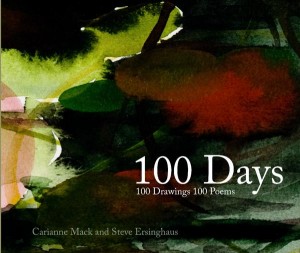
Proud to announce the availability of 100 Days:

091808l

By Carianne Mack and Steve Ersinghaus   sersinghaus

What’s inside 100 Days: the vivid relationship of color and sound, image and
metaphor, the seen and unseen bleeding through the soft white surface.

100 Days captures the pairing of a creative challenge by artist
Carianne Mack and poet Steve Ersinghaus to create a watercolor a day
and a poem a day for one hundred days over the summer of 2008.

Large Format Landscape 13×11 inches (33×28 cm) 204 pages

Published: September 17, 2008

Posted in LITERATURE | 2 Comments

LITERATURE: 100 Images – Showtime

I’ve directed you before to the summer project of Steve Ersinghaus and Carianne Mack over at Media Play; it is a poem and a painting produced each day for 100 days and both images, visual and textual took on a life that grew and matured by summer’s end.

I went to the opening last night at the Tunxis College gallery and seeing the beauty of the juxtaposition of the 200 individual pieces in the display was an artistic delight.

The show, called Wind Fall, will remain on display through October 9th with a gallery talk and reading scheduled for October 2nd at 6:00 p.m.  The Ersinghaus/Mack collaboration is also being presented in the form of a bound book that is available for sale through the artists.  Have a peek at the project over at Media Play, and you may contact Ersinghaus (sersinghaus@txcc.commnet.edu) or Mack (cmack@txcc.commnet.edu) directly if you have an interest in purchasing the book.

Posted in LITERATURE | 1 Comment

CURRENT AFFAIRS: Balance and Reason

Not for me to point you to yet another political commentary, but for me, I like Megan McArdle’s take on things, agree in a lot of cases, but just find her to be a no-b.s. intelligent voice on many of the things going on around us.  This, for example, I feel is spot on:

"It would be nice if everything that went wrong in the world was a
result of the scheming of our ideological opponents.  But the sad fact
is, stuff goes wrong.  All the time.  And there is usually no villain
behind it."

There are always a couple of ways of looking at things: the (Republican/Democrat) administration is responsible for the (good/bad) economy when in fact, it’s often just a case of who’s sitting on the throne when the economy drives itself up or down from forces not under government control.

Posted in CURRENT AFFAIRS | 2 Comments